A Love Letter to Salmon and Grizzly Bears
Sixteen days immersed in the Taku River watershed in Northern B.C.
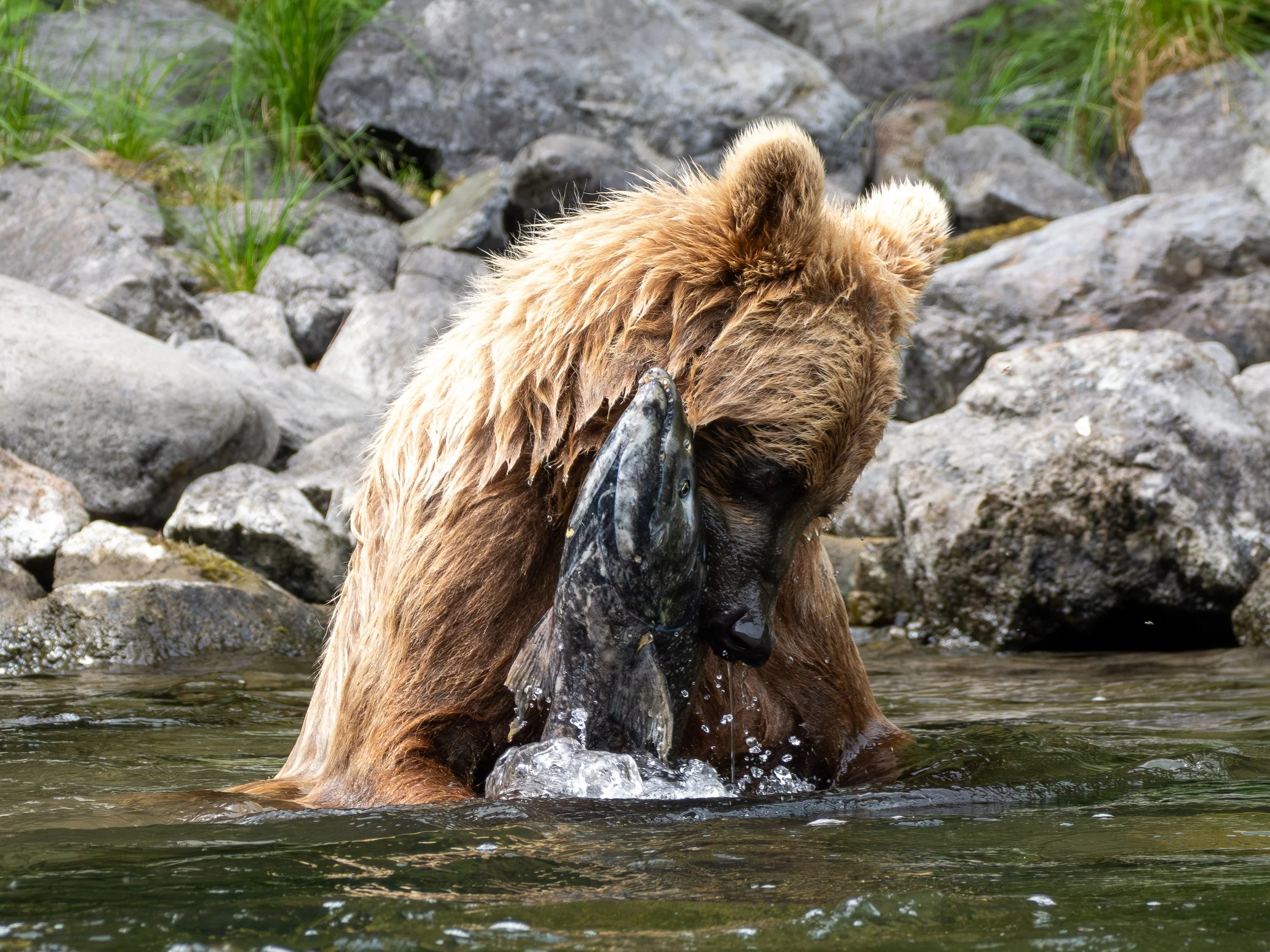
A mother grizzly bear hauls a chinook salmon out of a river in the Taku watershed. (Photo: Trina Moyles)
I keep trying for the words to reflect on my experiences along the Taku River watershed in northern B.C. last month—and failing. Maybe written language isn’t enough to describe it.
Maybe it would be better encapsulated in a dance. I am reminded of the KhoiSan master trackers in Werner Herzog’s film Ghost Elephants who practice “behavioural mimicry”, moving their bodies precisely in the way that forest elephants rub and mark their scent on a tree. One of the trackers lifts his elbows high, his arms and hands dangling, mimicking the ears of an elephant. The pulsing rhythm, the sway. His arms move so fluidly you forget they are arms and not huge wing-like ears. It’s as if the man transcends into animal state. The line between human and elephant blurs.
Being in close proximity with different wildlife species, observing their behaviours over over days, months, seasons, and years, invites embodied kinds of knowing. You cannot convincingly mimic the digging of a redd, or nest, like a salmon, or catch one like a grizzly, cradling it between your dinner-plate-sized paws, draping it over your forearm to tear into the flesh with your mouth unless you’ve spent many long hours memorizing their movements.
OR, Maybe the feeling of spending sixteen days alongside a salmon spawning ground is better expressed in sound.
The sound of gurgling water, rushing over rocks. Or, the sound of a male chinook hurling his blue-black body out of the water and pancaking on his side (“they aren’t ‘jumping for joy’ they’re trying to get debris out of their gills,” Phil tells me). The salmon leaps, pure muscle, and smacks the surface, three times: SLAP, SLAP, SPAP!
Or, how could I forget the sound that penetrates the dark of my small cabin constructed out of plywood. A full-bellied growl that progresses into a lion’s roar, echoing throughout the rocky valley. The sound injects like a drug. I shoot upright in my bed, my lips curl into an instinctive smile. I crack the window open wider. I feel fucking alive! My imagination conjures what I’m hearing on stereo: two hulking male grizzly bears standing head to head, their jaws wide open. They’re “jawing”, or “gaping”, rotating their open mouths around the other—without touching. Maybe you’ve seen dogs play this way, too. It’s a ritual for sorting out hierarchy and boundaries for the best fishing spots along the river. It’s a kind of dance. These big brutes aren’t looking for conflict. These are the big male bears that don’t like to be seen.
“One of the first things that grizzly bears learn about people is that we’re not nocturnal,” Phil had told me earlier that day.
Later that night, I hear the sound of large, padded feet pounding the dirt trail that winds past my cabin.
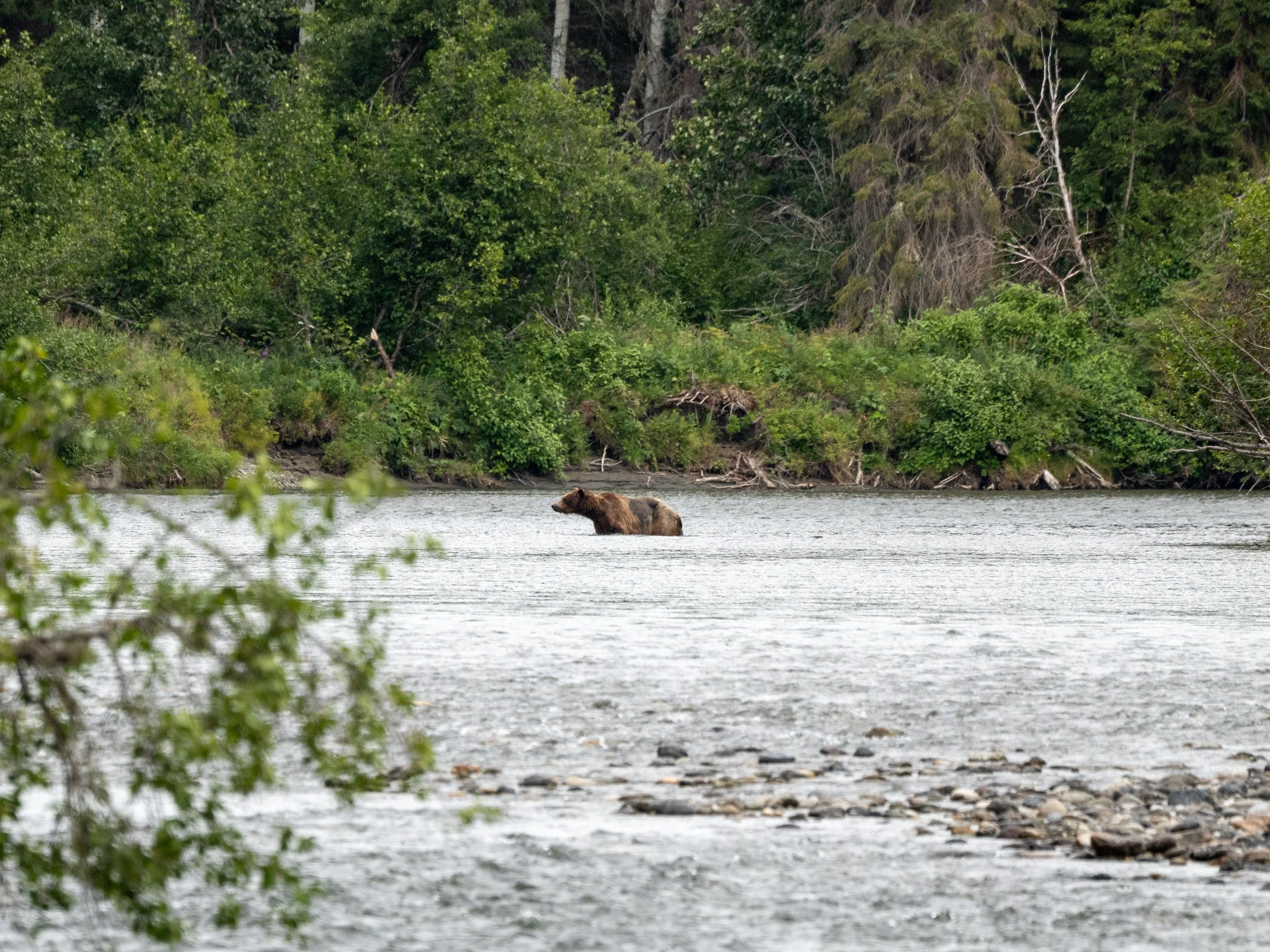
A large male grizzly fishing for salmon. (Photo: Trina Moyles)
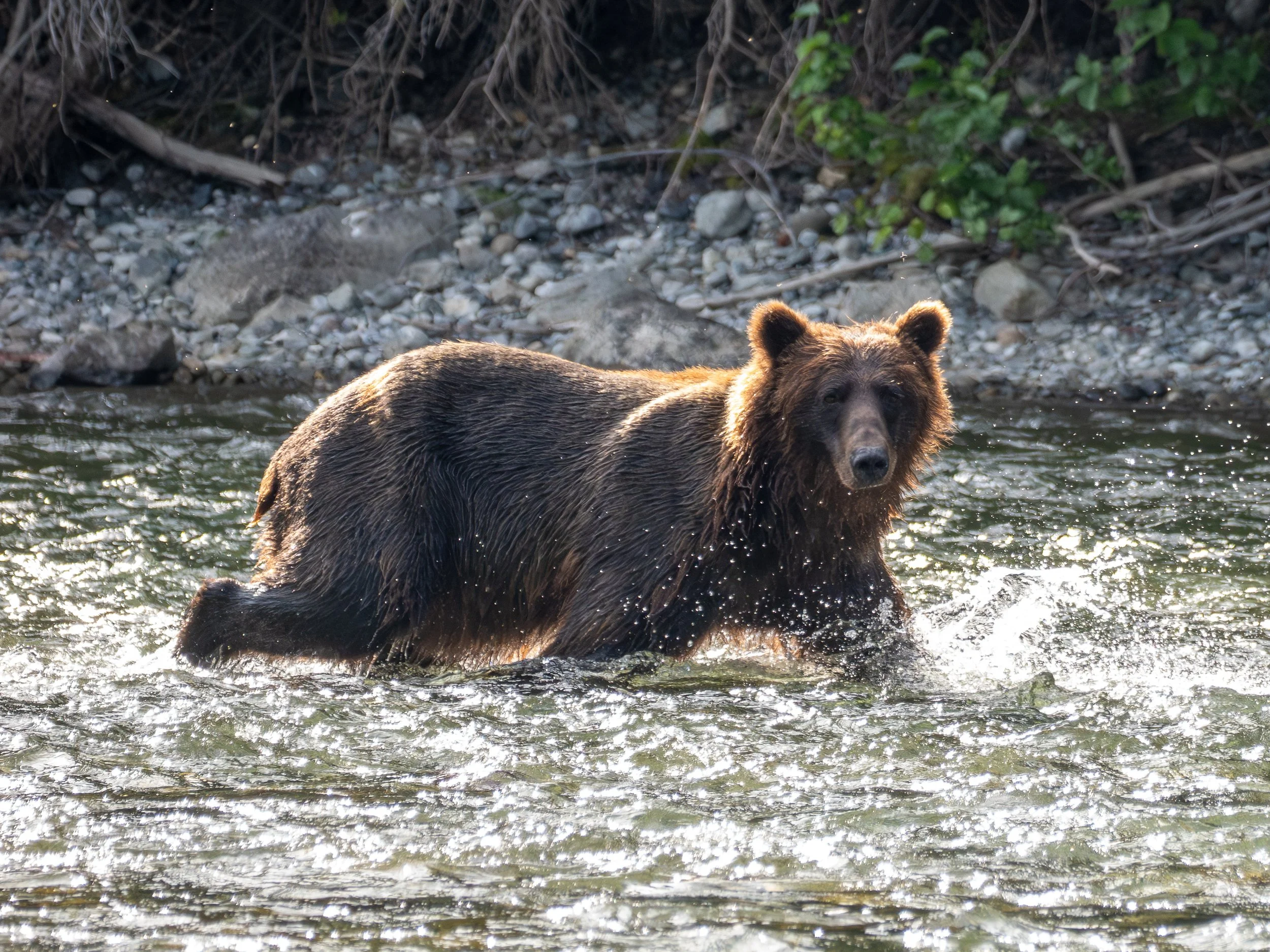
A male bear nicknamed “Roman” prowls the shallows along the river, looking for a meal of a female chinook salmon. Bears hone in on the female’s fatty eggs, the skin, and nose cartilage. (Photo: Trina Moyles)
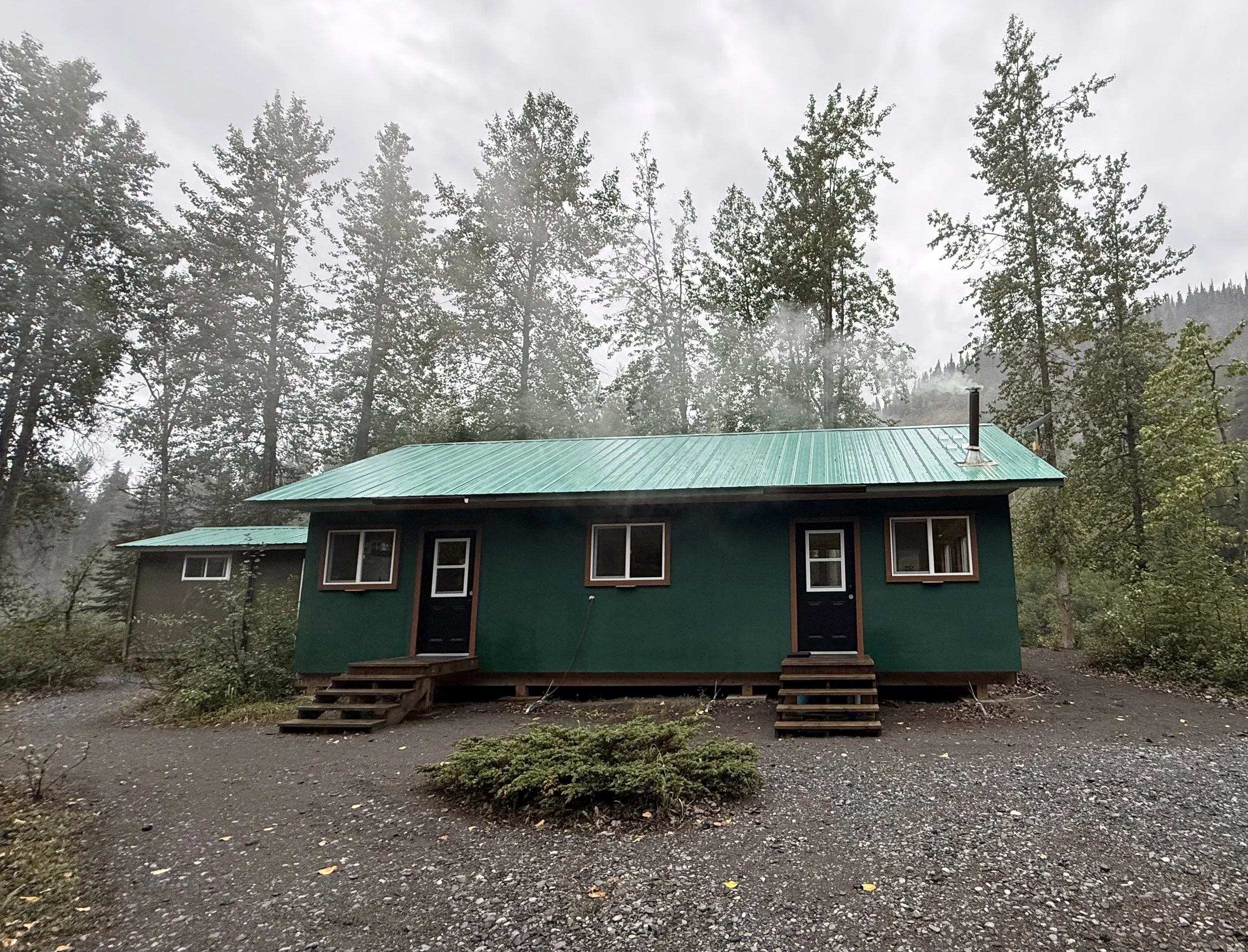
The main lodge, which is situated along the riverbank, looking over the spawning grounds of the pink and chinook salmon. (Photo: Trina Moyles)
In August, Phil Timpany, a veteran grizzly bear guide and fisheries specialist, invited me out to “bear camp” at Nakina Adventures. It’s one of the oldest commercial grizzly bear viewing operations in North America, which he co-owns and manages with his son, Ross. Like the grizzlies, Phil raised his kids here along the banks of the river.
In the early 1980s, Phil, while working as a fisheries contractor for the Alaska Department of Fish and Game, first flew over the Taku River watershed. When he looked down at the tract of river—where the chinook and pink salmon spawn—he could barely believe his eyes. The surrounding ecosystem stood out. Huge cottonwoods lined the banks like white pillars. Saskatoon and high bush cranberry bushes proliferated. The vegetation was thick and lush. What was happening here?
Phil urged the pilot to land and instantly became a lifelong student of this unique salmon-forest ecology. In the 1980s, he helped establish fishing weirs in the Taku watershed, where researchers continue to monitor the health of chinook salmon today.
He invented new ways for studying salmon spawning behaviours, including building “a coffin” that he could lay down in, immersed in the water, to closely observe the behaviours of females and males.
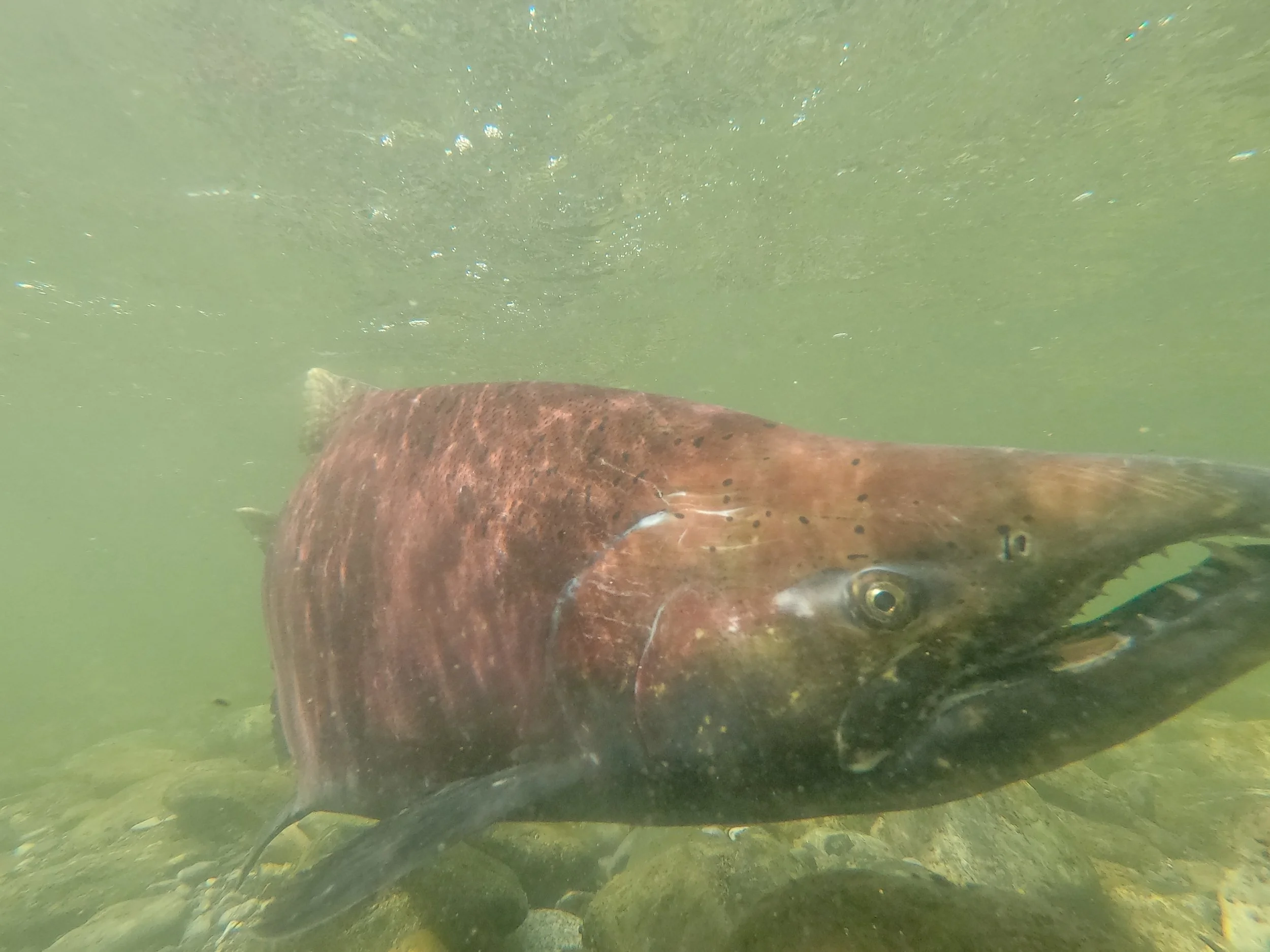
A male chinook salmon waiting for a female to dig her redd, or nest, and fertilize her eggs. (Photo: Trina Moyles)
Grizzly bears just came along with the territory, of course. They’re the true engineers of this ecosystem, hauling salmon out of the river, leaving carcasses on the banks to decay, and distributing their nitrogen-rich urine and scat into the terrestrial system. No kidding the diameter of the cottonwood trunks are so vast! The bears have engineered a substrate, a thick cap of organic matter, that feeds a lush forest.
In the early 1980s, while working at the fishing weir in the Taku, Phil had to figure out how to live closely with grizzly bears. This relationship was borne out of necessity. He studied the bear’s social dynamics, their individual traits and habits. He got to know them as individuals. He’s watched them raise families and generations of bears. Phil believes adamantly that bears deserve legal “citizenship”.
Forty years later, he’s still watching them today. And the grizzlies, of course, are watching him, too. COEXISTENCE IS ABOUT MUTUAL learning.
In 2025, I reached out to Phil to interview him for a magazine article about recreating in bear country with dogs. We wound up chatting on the phone for 2.5 hours that day, and I sensed it would be the first of many conversations to come. A few months later, I sent him an advanced reader’s copy of Black Bear, which he was kind enough to read. He enjoyed the book (and I nearly died of happiness) and it cemented our friendship and mutual love for bears. Phil agreed to speak at my book launch in Whitehorse in January, and I was thrilled when he asked if I’d like to visit “bear camp” the next summer. YES, I responded enthusiastically. I would plan my entire summer around it. I counted down the days until my departure.
As I packed my bags in our one-room yurt outside of Whitehorse, I casually mused aloud to my partner, Mike.
“Maybe Phil needs another bear guide.”
Mike gave me a knowing look.
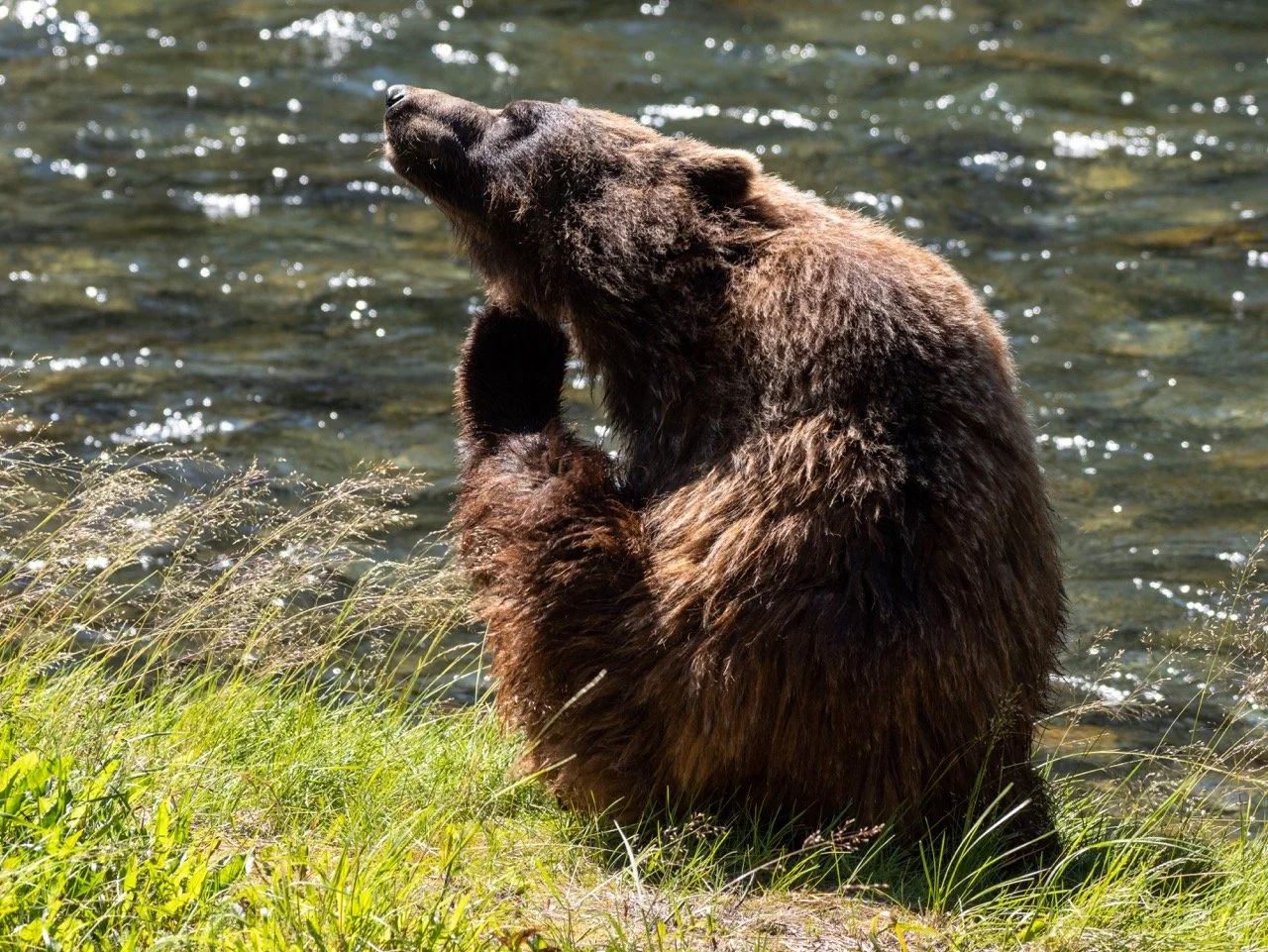
A small female grizzly bear casually scratches her chin to send a message to us: she isn’t a threat. (Photo: Trina Moyles)
The next day, only minutes after arriving, a small female grizzly saunters along the riverbank below the viewing platform where we sit. Her coat is long and shaggy. She is incredibly relaxed, she doesn’t even look in our direction. The small female plops herself down in front of the platform, gazes out longingly at the fast-flowing river, and lifts her hind leg to scratch her bearded chin. One leg, then the other. Vigorously, she scratches.
“There’s a lot of communication going on right now,” Phil whispers to me. He then mimics her, lifting a hand and turning his head sideways to casually scratch at his neck. He looks exactly like her. “She’s scratching as a way of letting us know, she isn’t a threat to us. She isn’t bothered by us.”
Over the next two weeks, I’ll watch bears communicate with one another in this same way. I’ll see Phil do it, too, only it’s barely perceptible. I’m not sure the other people with us even realize he’s doing it. But the bears do, of course. They’re at ease. They’re the most relaxed bears—aside from Osa, the female black bear who denned close to my fire tower—that I’ve ever interacted with. They know the rules: no touching of the wooden viewing platform, the lodge, or cabins. Over the years, Phil and Ross have reinforced the boundaries. If they respect the rules, the grizzlies are free to come and go through camp.
This is their land, after all. These are their berry bushes. These are their trails that lead up the mountain, or through the forest. And these are their salmon.
Phil and Ross return the respect by visiting only 3 viewing sites that take up less than 0.2 percent of the bear’s habitat along the spawning grounds. The rules for human visitors are also regularly enforced: no talking, no sudden movements. It’s like a silent retreat.
Some bears are so relaxed they choose to be in close proximity to camp. There’s a huge cottonwood tree that stands only a few metres away from the wooden viewing platform. One side of the tree is well-worn. This is a “rub tree”, a place where bears come to scratch their oily backs against the rough bark. They stand, urinate, and stamp around more scent on the ground. They leave behind love letters, of their own making, to one another through scent.
A 19-year-old male grizzly, nicknamed “Spot” for the iconic brown spot on his collar of white fur, lumbers up from the river towards the rub tree. We sit, in silence, watching Spot approach. He scents the tree and rubs his side up against it. Then lifts upright and thrusts his head back against the bark and rubs up and down. Male bears have specialized sebaceous scent glands located in the skin of their backs and shoulders.
Across the river, another male bear wanders by. Spot stops and gazes down at him. The other bear lifts his head, and opens his mouth slightly, trying to get a scent. They are both calm. The other male disappears into the forest. Spot resumes a good, long scratch. Not even once does he look over at us on the viewing platform. He stays for five minutes before lumbering back down to the river.
Later, I remark to Phil, “That’s one of the most laid back bears that I’ve ever been close to.”
“That’s the result of respecting a bear for 19 years,” he says plainly.
Time slows down, watching the grizzlies. One day feels like a week. And a week feels like a month. My nervous system completely relaxes, listening to the constant sound of the river flowing by. I grow fond of the sound of a grizzly bear munching on a salmon. CRUNCH! It’s like someone taking a large bite out of an apple. I love learning how to identify the individual grizzlies by their unique appearances, or their behaviours.
At some point, Phil turns to me and asks, “Have you ever considered joining us as a guide?”
“I think,” I say wistfully to Phil, “That I could probably watch bears for the rest of my life.”
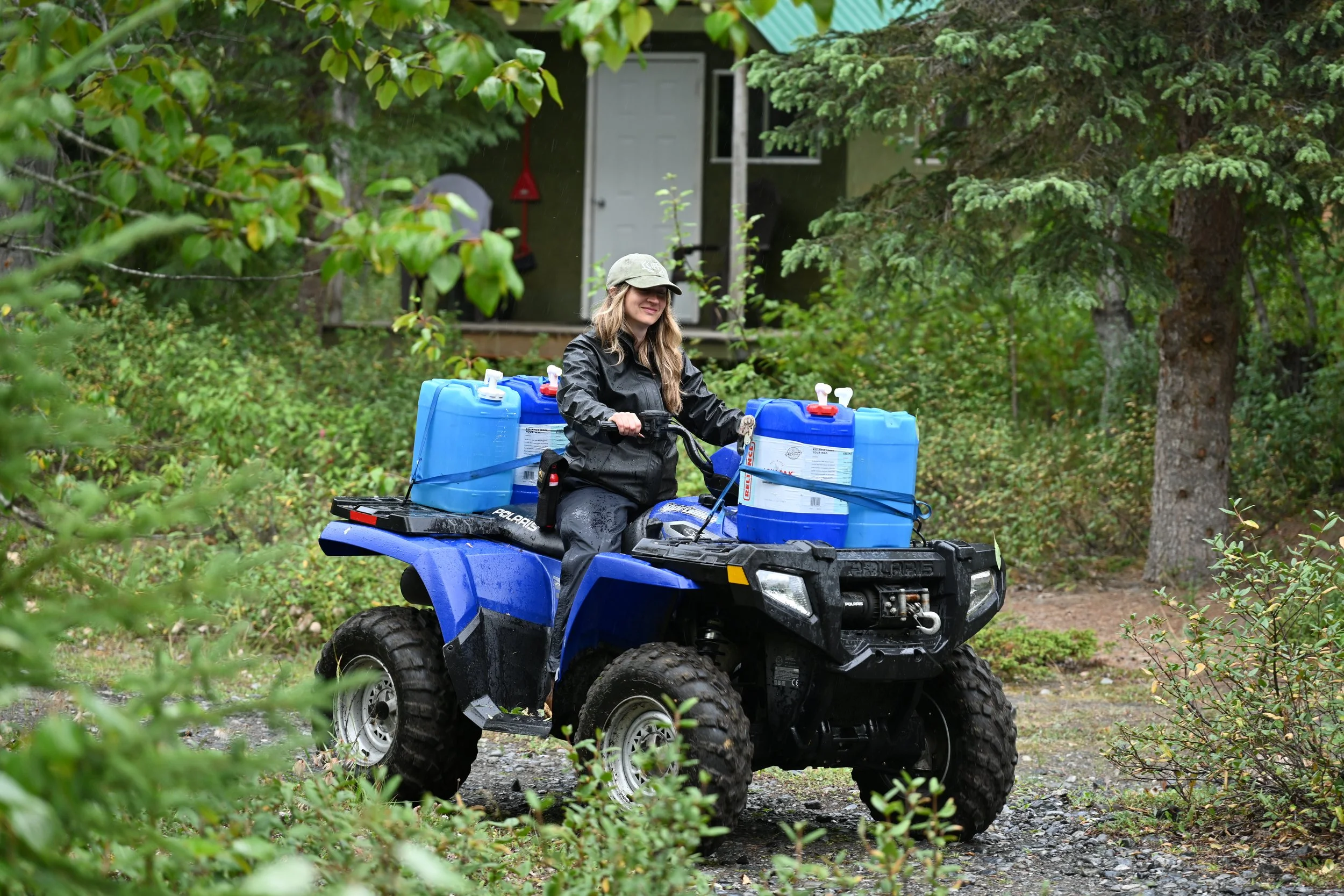
Living the good ‘blue jug life’ out at bear camp in the Taku River watershed. (Photo: Ingolf Jährig)
Moreover, I could probably watch salmon for rest of my life.
I’d never really thought about salmon as “individuals” until earlier this summer when I visited Abbey Irwin, a fisheries technician with Fisheries and Ocean Canada (DFO), at the Klukshu chinook salmon monitoring station in southwestern Yukon. Abbey is tasked with counting, measuring, and assessing the health of every individual chinook salmon that swims through the weir. They are all uniquely different in terms of size, age, colour, shape, and appearance. What they share in common: they are survivors. Many bear the scars of eagle talons, or seal bites. Salmon face so much uncertainty navigating their way back to their natal spawning grounds.
I thought of Abbey’s work with the chinook salmon along the Klukshu River while I was in northern B.C. I wanted to get a closer look at the salmon, so Phil helped me position an underwater GoPro at the edge of a “redd”, a shallow depression in the rocks and gravel, dug out by a female, for spawning her eggs.
It was a fascinating window into the behaviour and ecology of an individual female chinook, or a “hen”, as Phil called her. For days, the hen dug her redd by turning on her side and vigorously flapping her caudal fin, or tail fin, displacing sand and gravel. She dug with her tail fin for several days, deepening the redd and polishing the rocks clean.
Some females, Phil explained, would dig until their tails were completely worn out, thin as tissue paper. She exerted additional energy, chasing away other females who ventured too close. I had no idea that salmon were so territorial. Sometimes we could see them at the surface, violently splashing across the water.
By this point, she’d chosen her mate: a deep red male chinook. A real “hunk”, Phil said jokingly. He was often at her side, even as she dug, readying himself for when she’d start to lay thousands of eggs in her redd. And he wasn’t alone. Other males of different sizes and colours lurked nearby, hoping to swoop in and fertilize her eggs.
If you’re wondering, we did manage to capture the “money shot”. The female swam low in her redd, using her anal fin to locate the crevice where she’d lay the eggs. In a climactic moment, she spawned, opening her mouth in a very obvious O and at least five different males, including the red hunk, rushed to her side, turning the water a milky white shade.
The female then returned, using her tail fin to cover the eggs with a light film of sand. This would go on and on for hours, maybe another day, until she’d laid anywhere from 3000 to 14,000 eggs. For days, even weeks after she’d guard the redd with her life—until she had no life left in her.
Maybe a bear would pluck her from the waters. Maybe she’d be swept by the current and get caught up in a tree snag. Maybe an eagle, or otters would score her carcass. Whatever happened, she’d come full circle.
She, and every other salmon in the river, were feeding the wider ecosystem.
(Video by Trina Moyles and Phil Timpany)