Keeping Watch
WHAT’S IN A DAY’S WORK AT CANADA’S NORTHERNMOST FIRE TOWER?
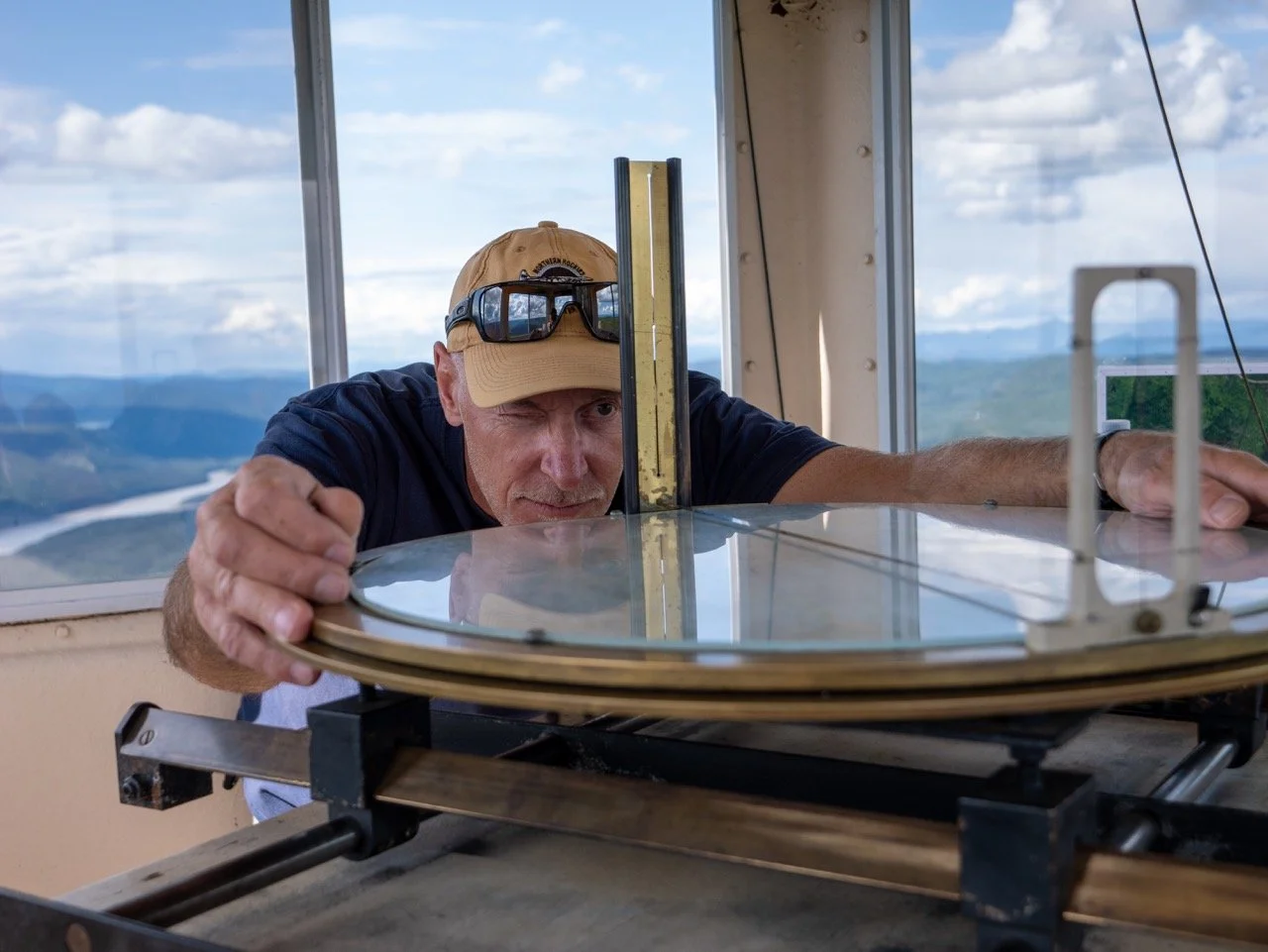
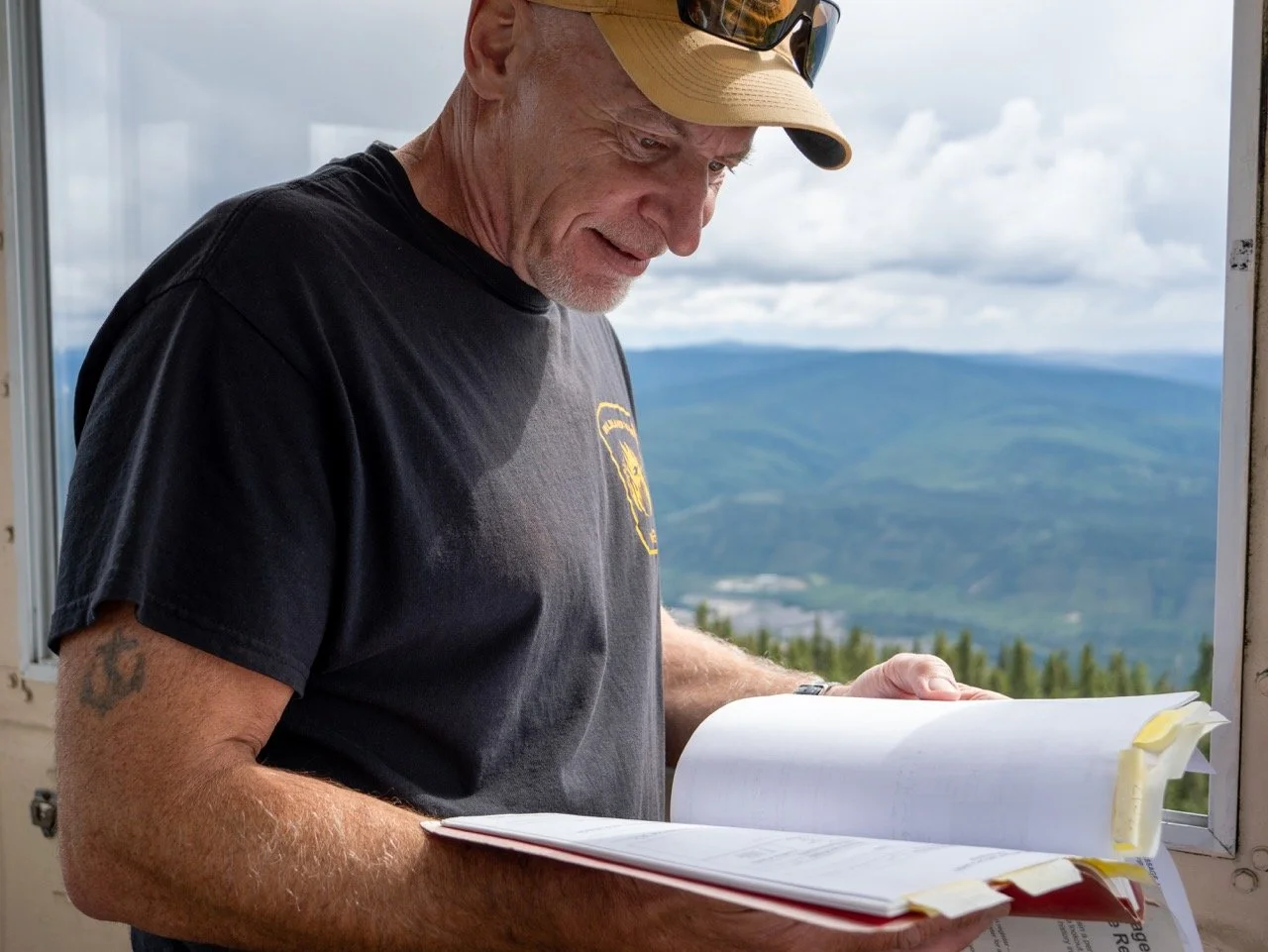
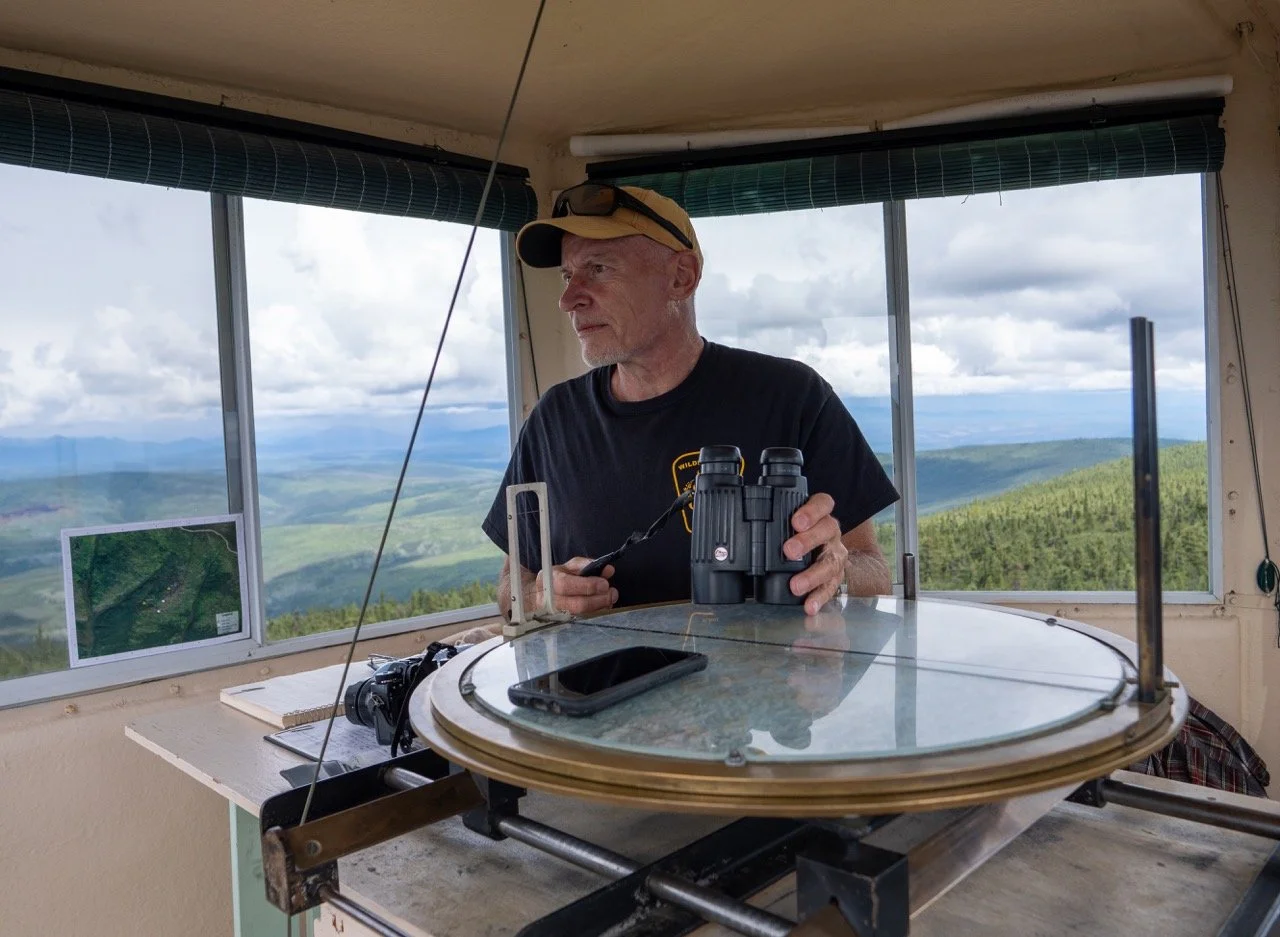
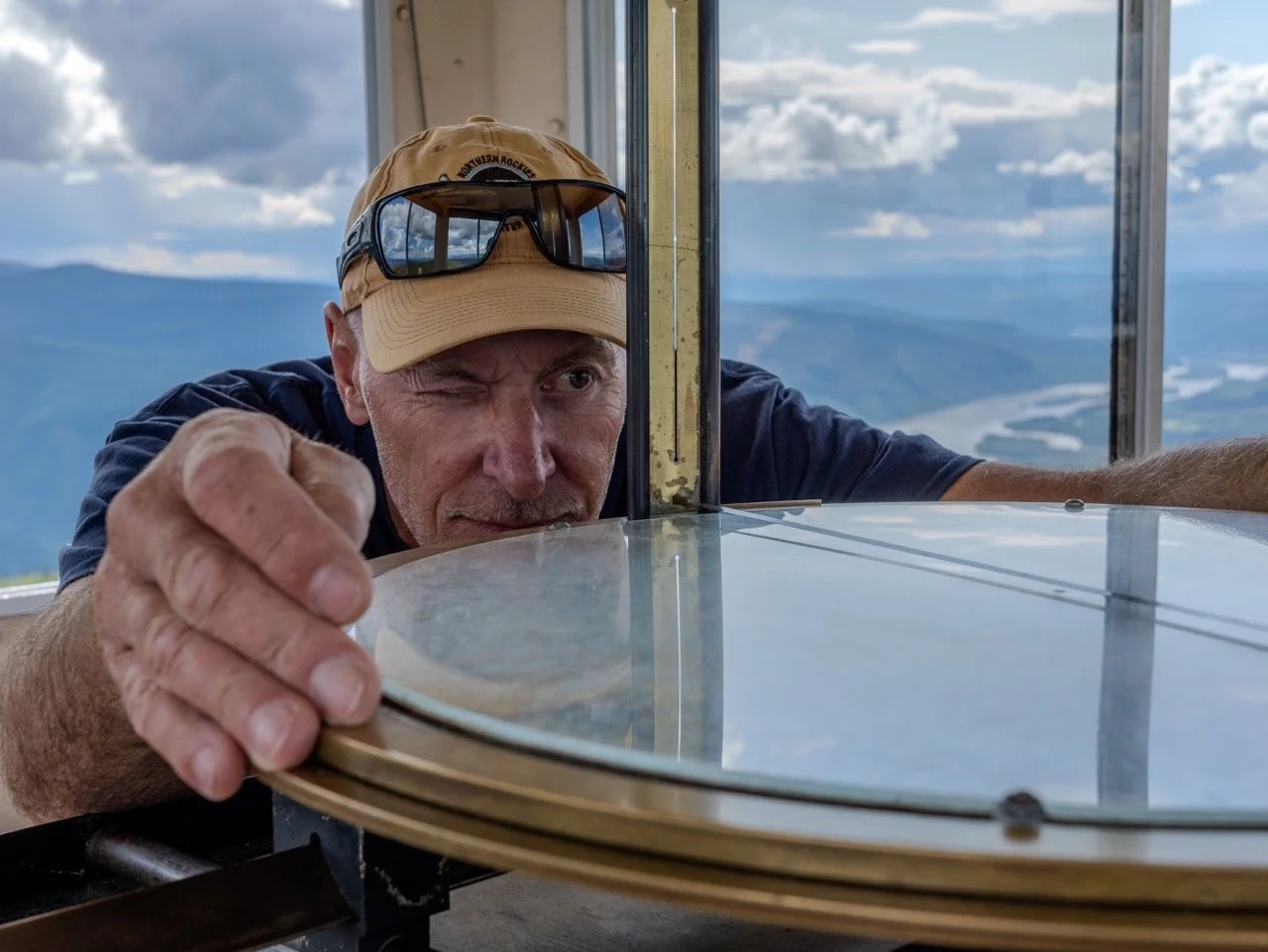
Markus Lenzin, one of Canada’s northernmost lookouts, uses the Osborne Fire Finder, a large compass, to find the corresponding bearing and location of a wildfire. (Photo: Trina Moyles)
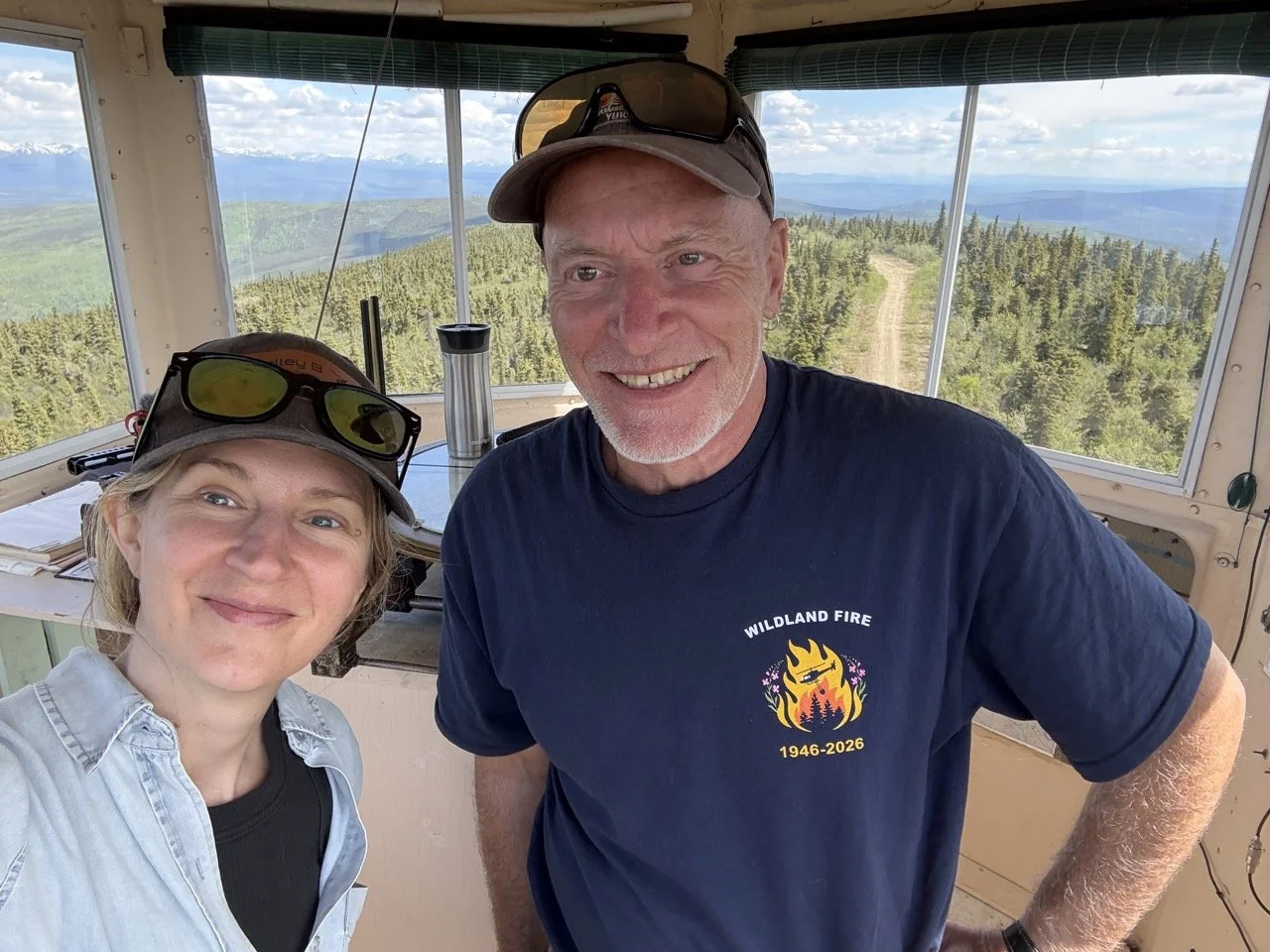
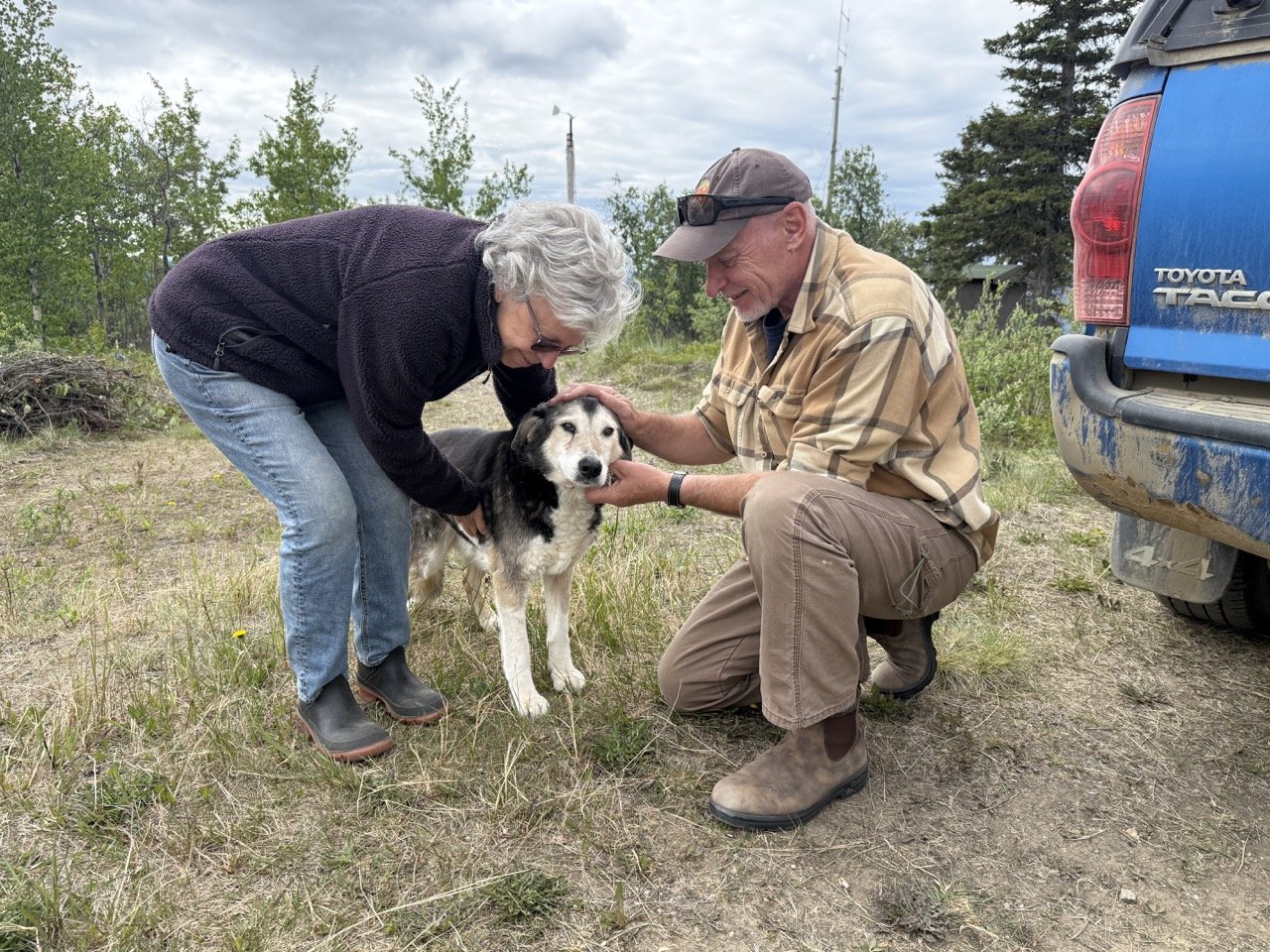
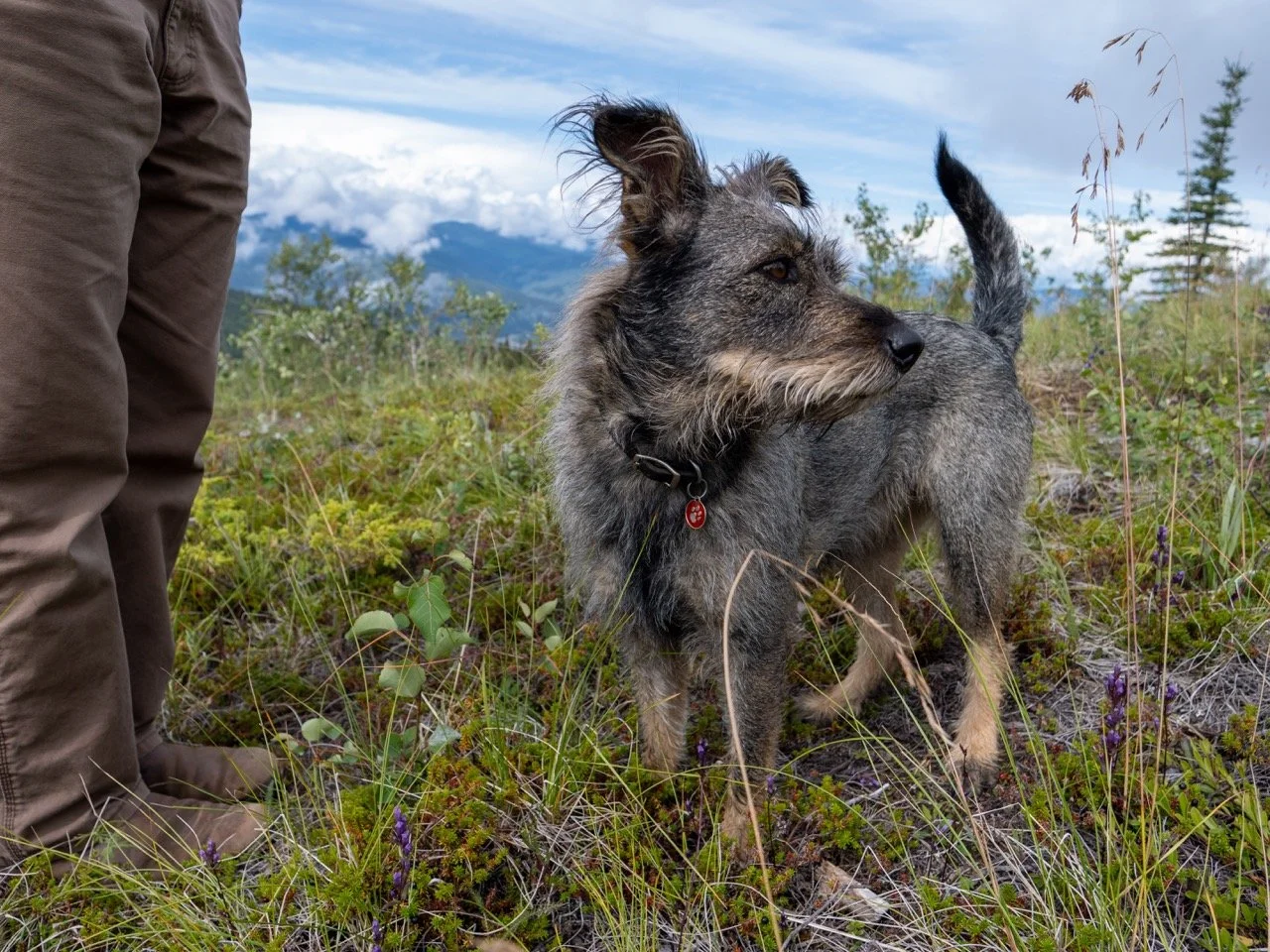
Several years ago, I traveled to Dawson Lookout, one of Canada’s northernmost fire towers, to interview the lookout, Markus Lenzin, for a magazine article. Markus has an esteemed reputation as as lookout in the Yukon. “He’s got a hawk eye!” more than one person remarked to me. In July 2024, I spent several days with Markus and his wife, Elfie, and their adorable tower dog, Tilda, interviewing and photographing him for the story.
On that visit, Markus was just as curious about interviewing me about my experiences as a lookout in Alberta as I was about interviewing him. We became fast friends. Since 2024, every fire season, I journey North to spend time with Markus and Elfie.
I wanted to share the original article, published in North of Ordinary Magazine (now The Yukon Magazine) in their Winter 2024 issue, with an updated post-script based on my recent visit.
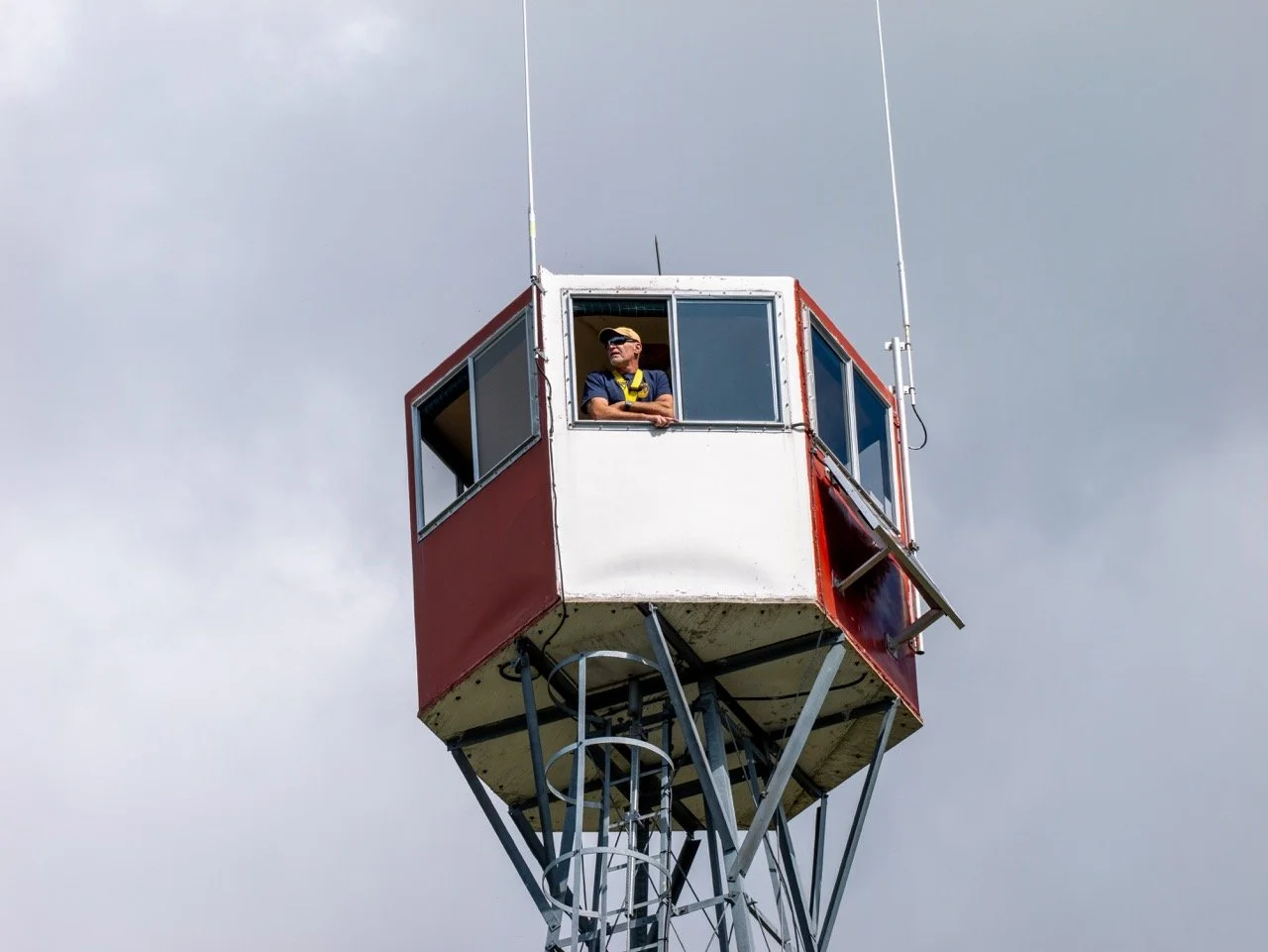
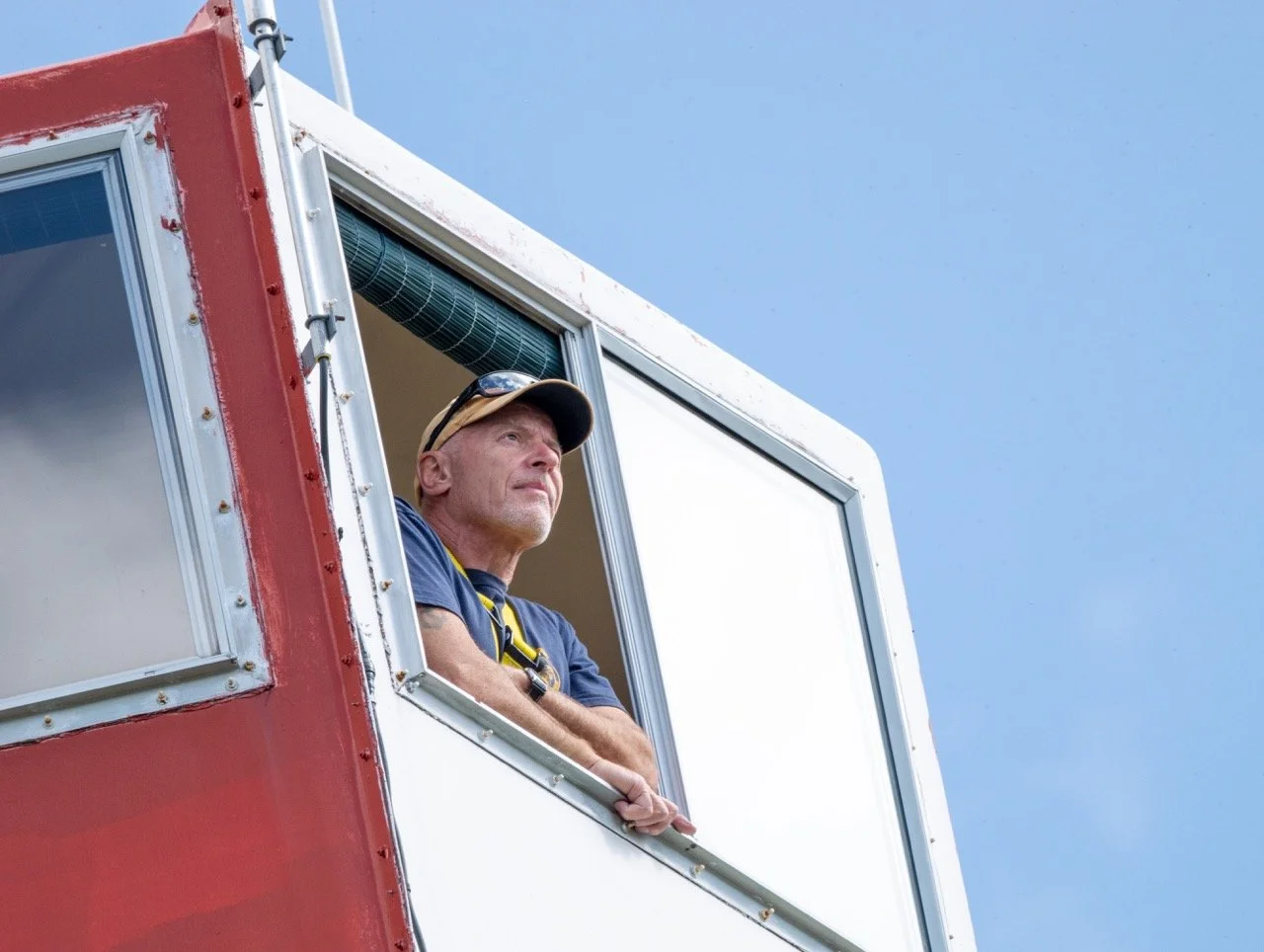
Markus Lenzin has a been a fire watch in the Yukon for 20 seasons now, with 15 of them at Dawson Lookout. (Photo: Trina Moyles)
Standing outside the Dawson City airport, Markus Lenzin looks like a lookout. He wears khaki shorts, a navy-blue YUKON WILDFIRE t-shirt, and a faded green bucket hat, but it’s the Blundstones that are the dead giveaway. I glance down at my own worn pair. I learned early on in my career as a lookout that they’re the best boot to slip on when you’ve got to make a mad dash up the tower to take a bearing on a smoke.
For seven years, I worked as a fire tower lookout in northwestern Alberta. When I moved to the Yukon in 2023, I was surprised how few Yukoners realize the essential role fire towers play in wildfire detection. Several have been shut down in recent years (like those along Kusawa Ridge and atop Paint Mountain), but five towers remain actively staffed in the Yukon. They’re positioned strategically. Sites overlook Watson Lake, Tagish, and Carmacks. The Ferry Hill Lookout watches over Stewart Crossing and Mayo. Lenzin has kept vigil for wildfires at the Dawson Lookout—the northernmost staffed fire tower in Canada—for the past 15 summers.
“It’s the best job in the world,” he told me over the phone, several weeks earlier. Originally from Zurich, Switzerland, Lenzin has been living in the Yukon for more than 30 years. He worked as a canoe guide in southern Yukon for 15 years before applying to be a lookout with Yukon Wildfire Management. These days, his reputation as a lookout precedes him. A friend of mine works as an Initial Attack firefighter in Watson Lake. Her crew spent two weeks responding to lightning fires that had been reported by Lenzin in late June. “The lookout in Dawson is a hawk!” she texted me. “Very impressive catches.”
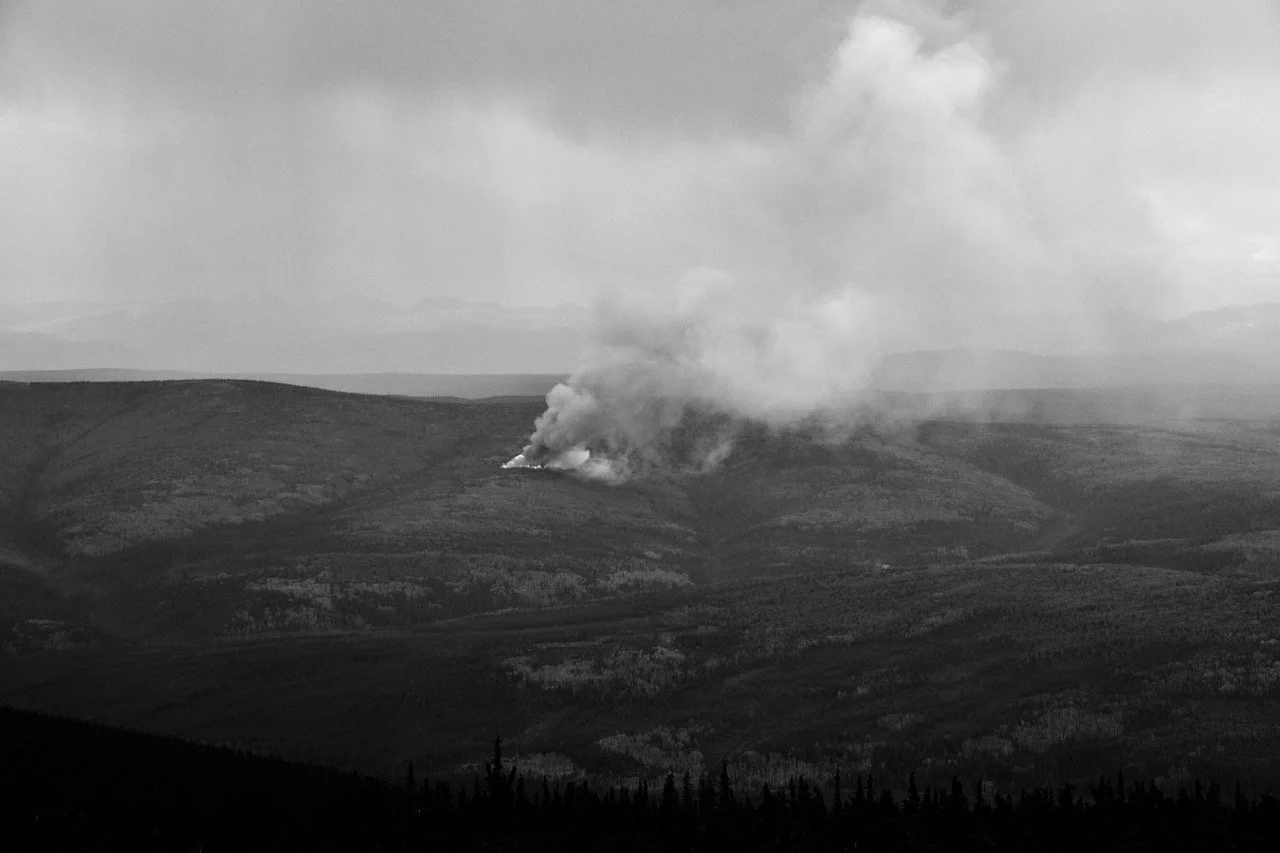
The name of the game is catching smokes quickly, so initial attack crews can manage them when they’re still small. This is the Moosecreek Fire from the 2024 season. (Photo: Markus Lenzin)
With climate change, the early detection of wildfires has never mattered more. Over the past several years, many communities in Western Canada have been evacuated, or burnt over by fires. Most recently, one third of Jasper, Alberta, was destroyed by a wildfire. Dawson City, a historic town “made of wood,” is surrounded by coniferous forest. People appreciate that there’s someone watching.
At the airport, a Dawsonite comes up to Lenzin.
“Oh, my son’s girlfriend mentioned to say thank you for letting the crew know about the wind shift on the Moosehead Creek Fire,” she says. “They felt safer knowing that you were watching.”
A good lookout doesn’t just call in wildfires so crews can extinguish them quickly, but continues to observe for wind shifts and communicates over the radio with ground crews, often relaying information to the Fire Centre. This is important because firefighters typically work on the flank, or in “the black” (the burnt area) of a fire, but a wind shift can swiftly push the blaze back towards firefighters and create dangerous conditions.
As we drive up Dawson’s winding Dome Road and branch off on a steep gravel road that leads to Dawson Lookout, I tease Lenzin about his legendary reputation.
“Folklore,” he shrugs and credits the strong sense of camaraderie to “firefighters, dispatchers, warehouse and air-tanker personnel, and wildfire managers” in Dawson City.
“I like to think of myself as the eyes,” he says. “And the fire base is the brain and the firefighters are the arms and legs. So it’s really a team effort.”
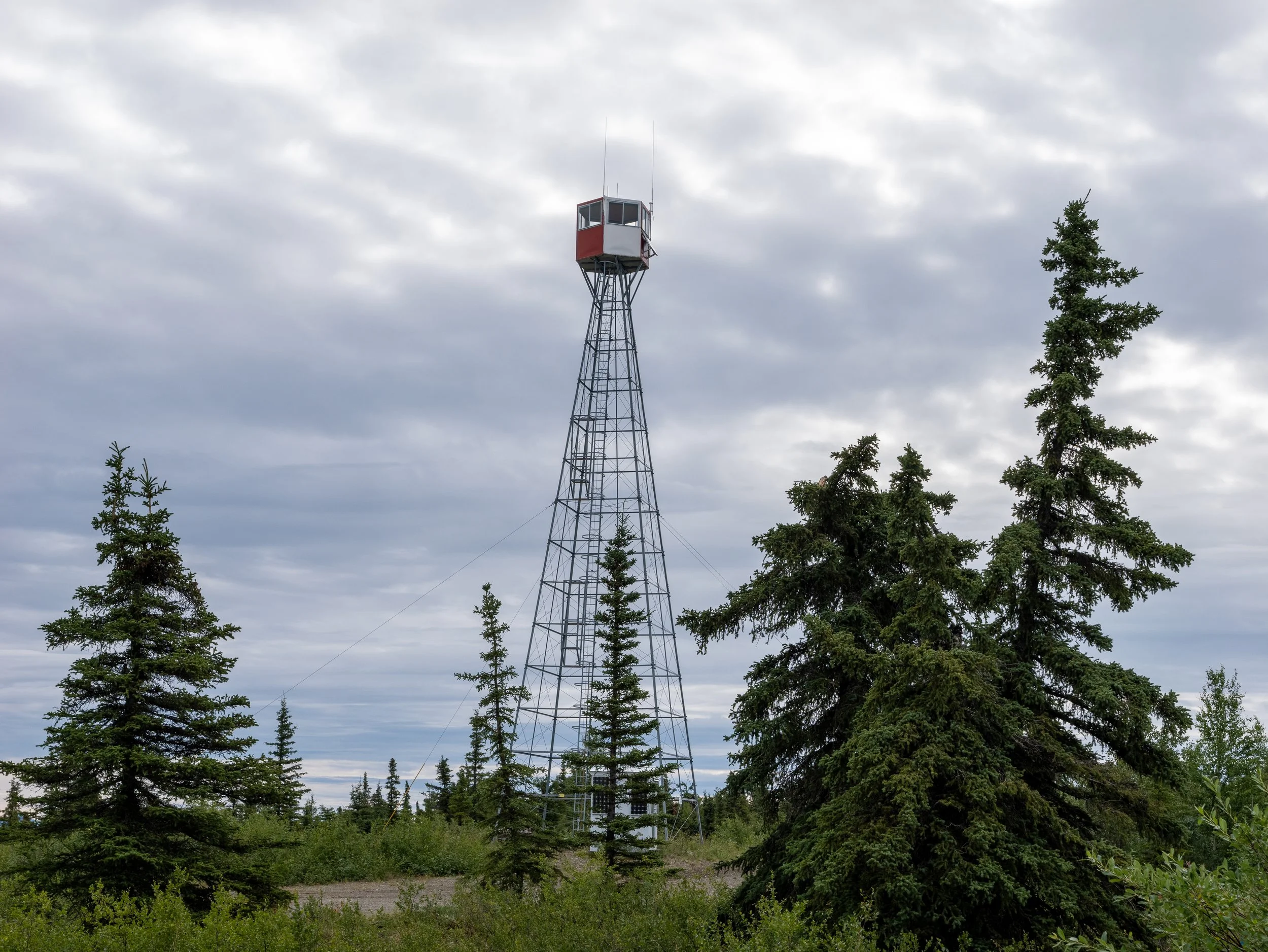
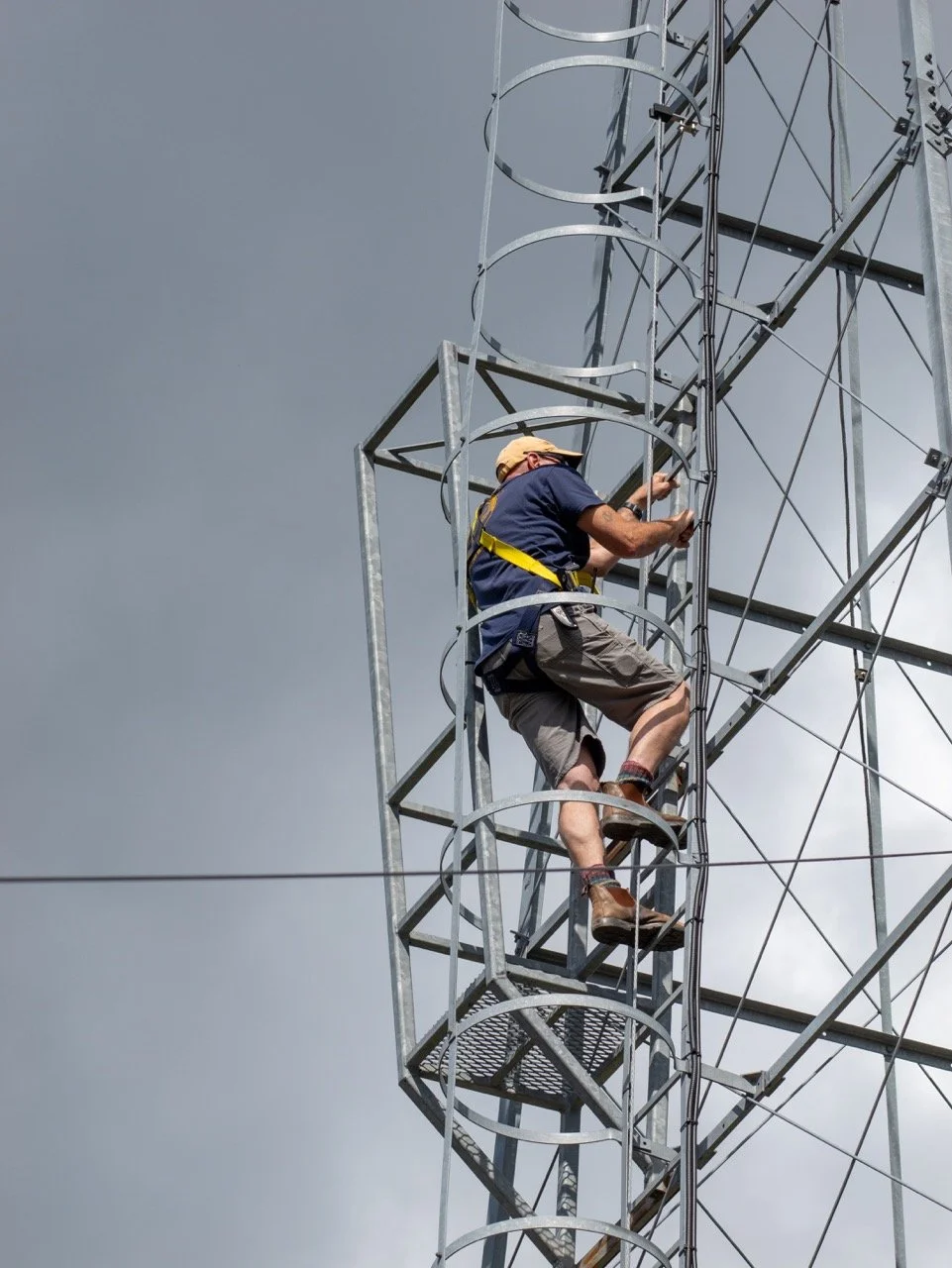
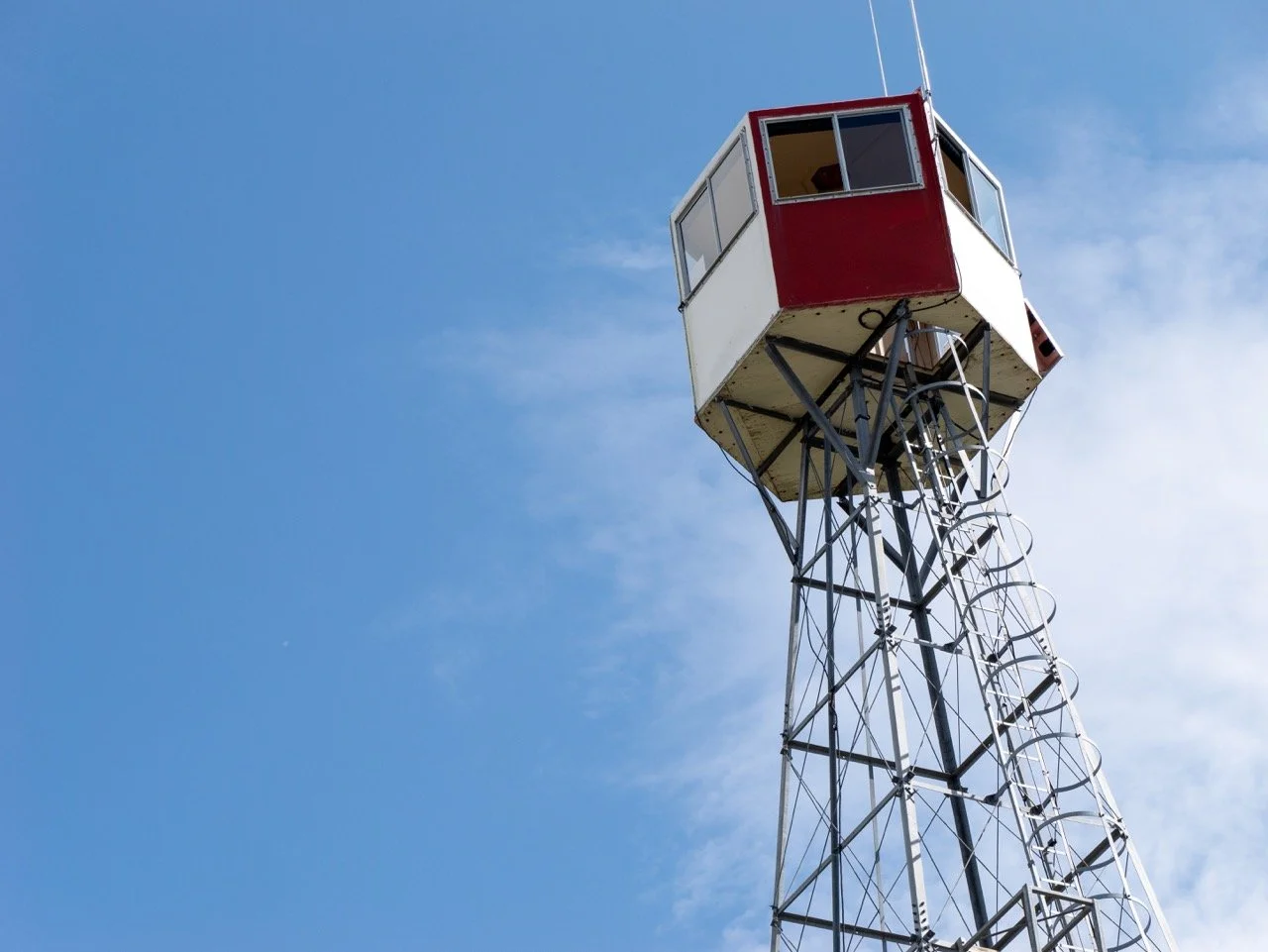
The Dawson Lookout is a 70-metre tall tower, originally build in the mid-to-late 1960s. (Photo: Trina Moyles)
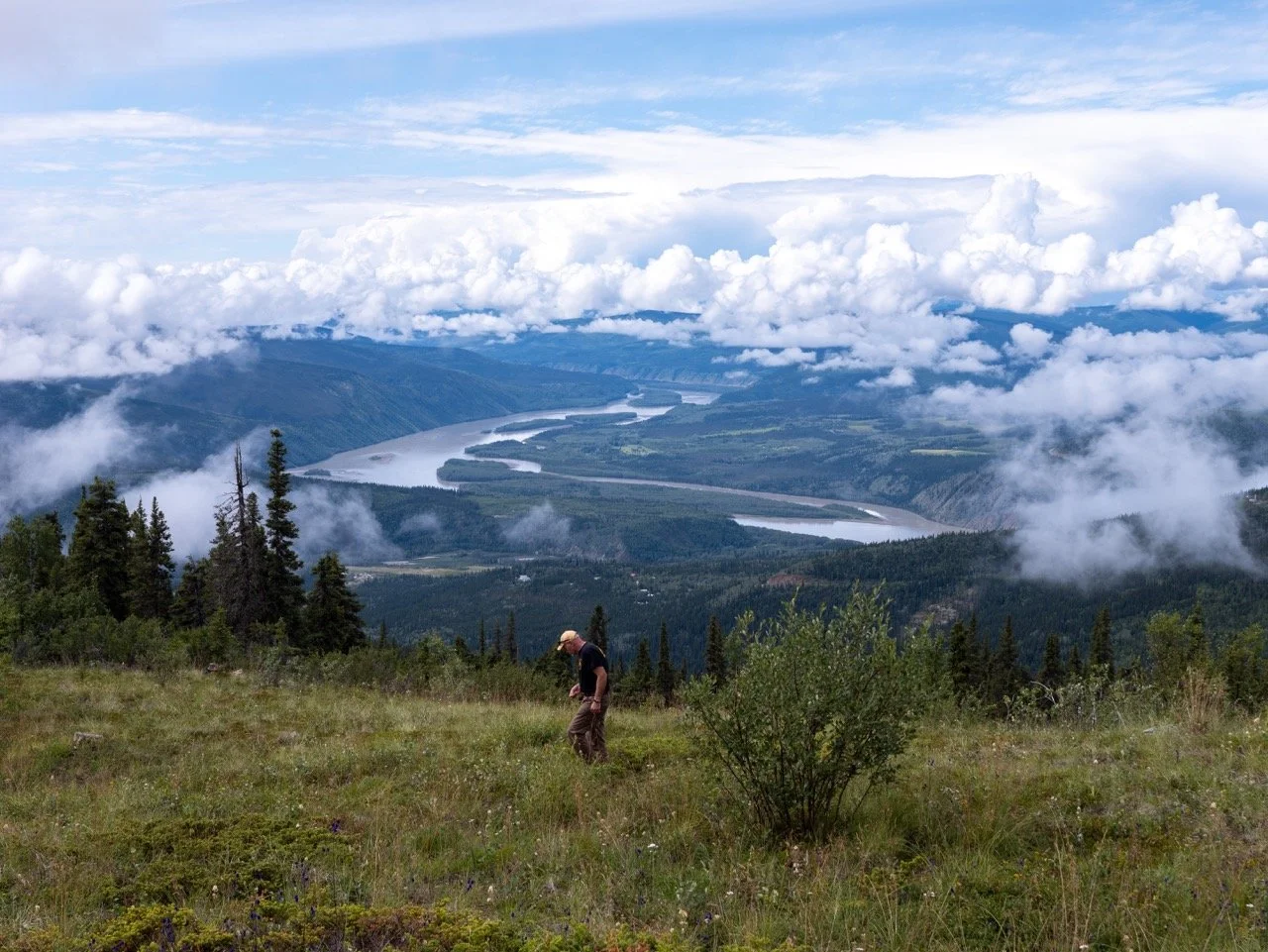
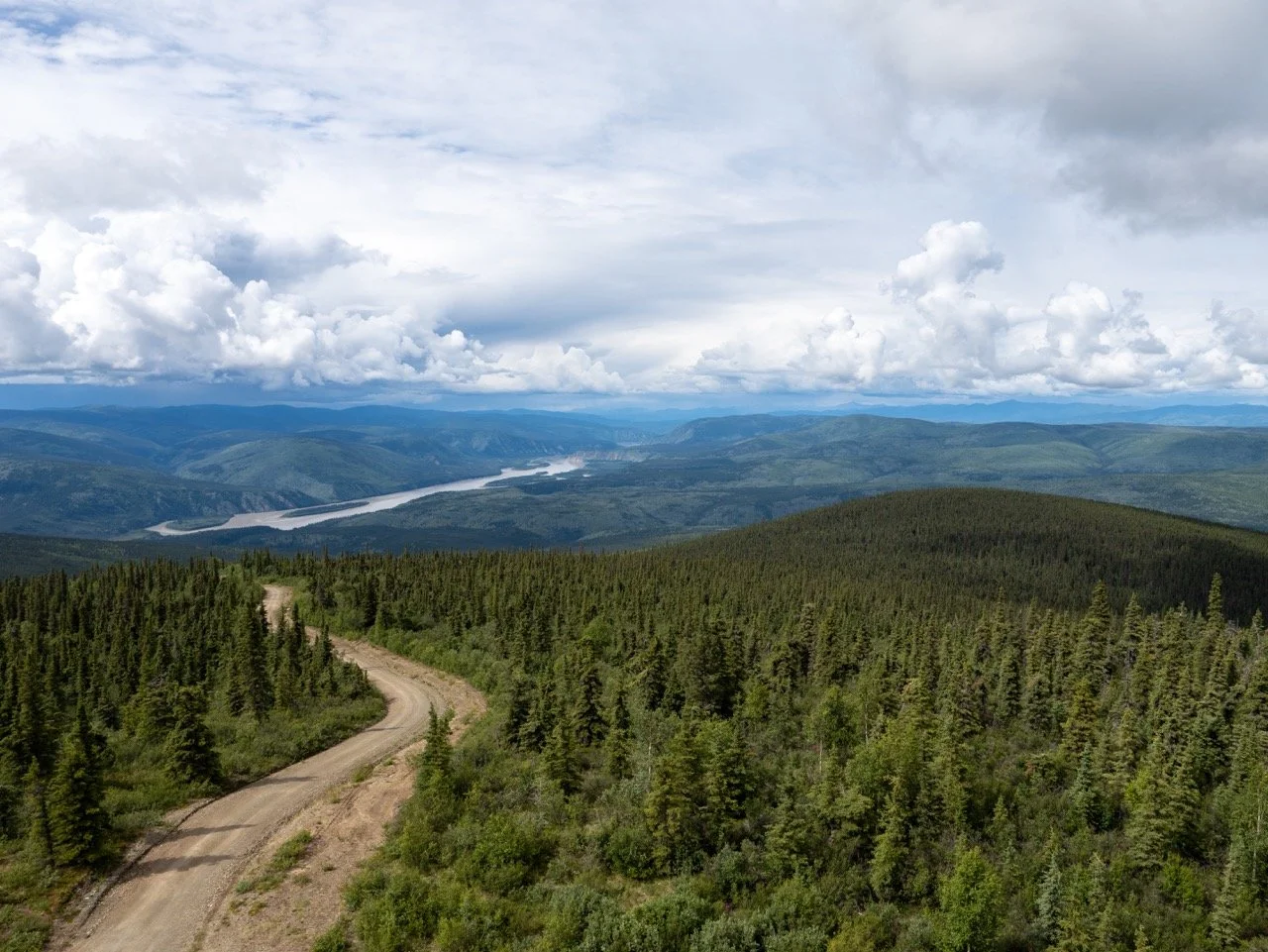
The Dawson Lookout, built as early as 1965, is perched atop what Dawsonites refer to as the “Second Dome,” a grassy hilltop overlooking the Midnight Dome with the town of Dawson hidden below. A modest log cabin with a front porch looks out on a spectacular view of the confluence of the Klondike and Yukon Rivers.
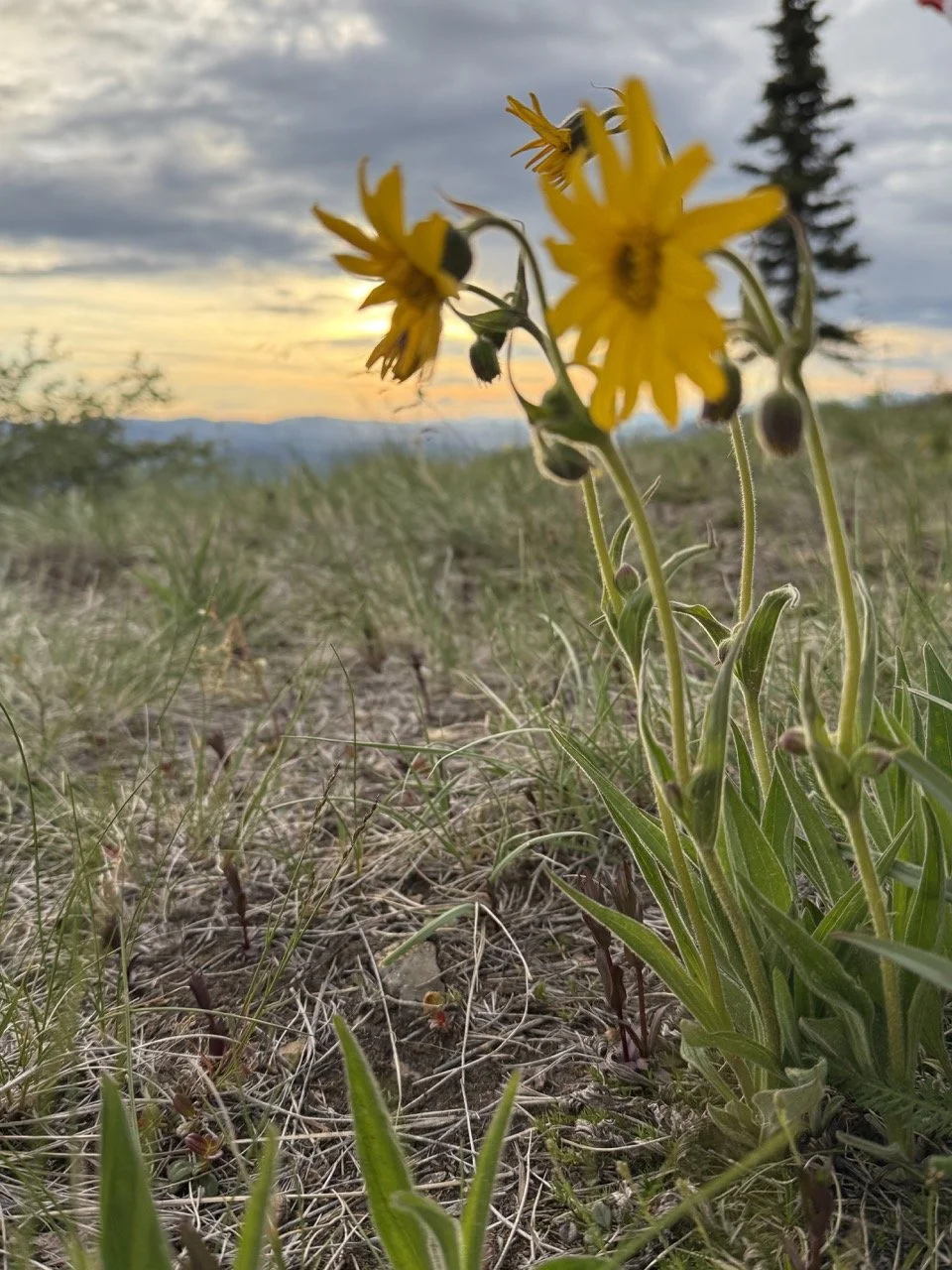
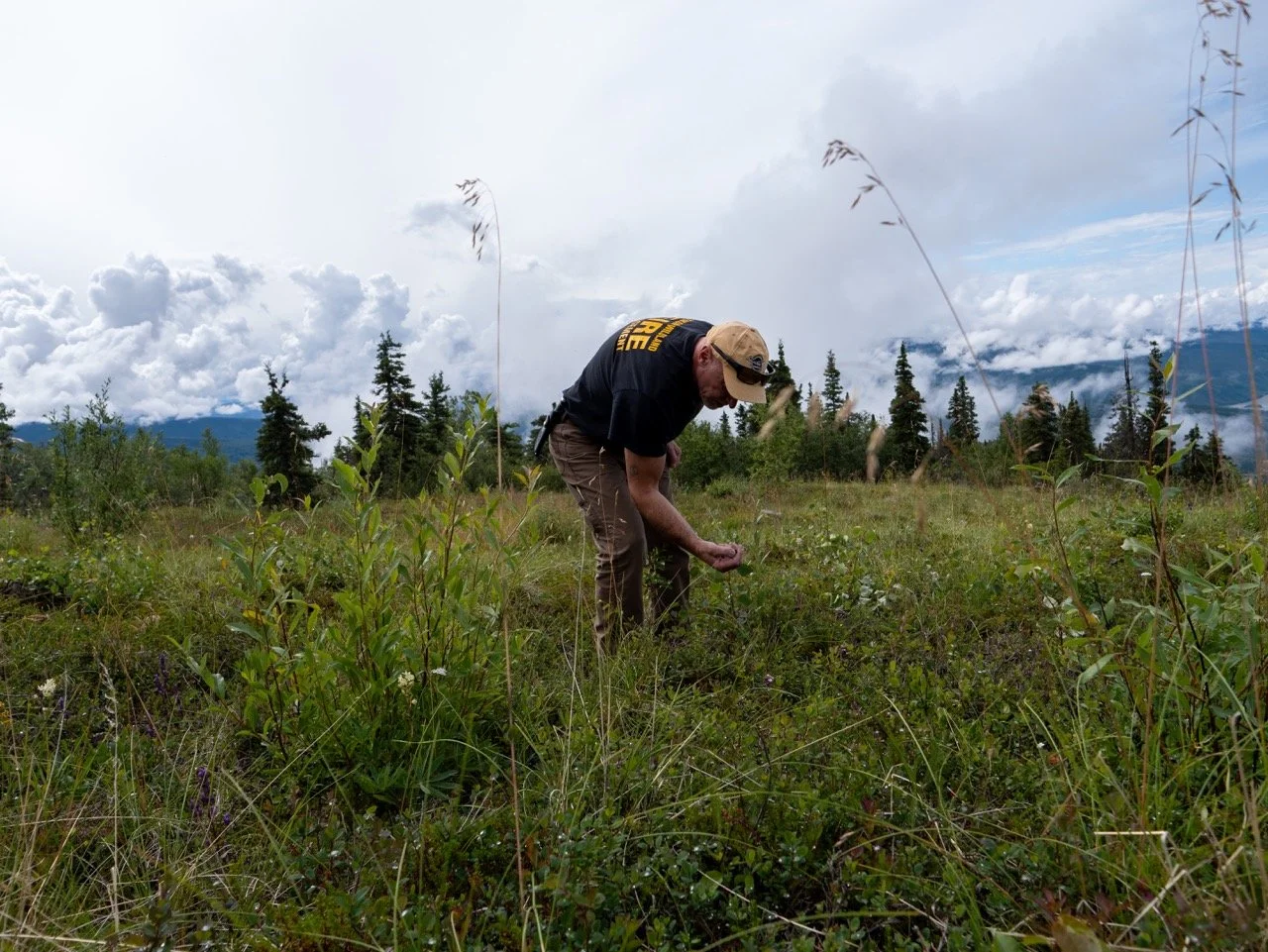
Lenzin knows the surrounding land by heart. He points out the mane of wildflowers on the north slope: gentian, monk’s hood, fireweed. He bends down to sample a few fat blueberries. “Not yet ripe,” he says. Tilda, his terrier mix, barks and circles me outside Lenzin’s cabin, which is outfitted with a gravity-fed water tank that flows into the kitchen. There’s a stack of split wood piled next to the cabin. Lenzin doesn’t get bored out here. Even on rainy or foggy days, when he’s down on the ground, there’s always something to fix, or paint. Lenzin loves to read and will occasionally drive to town to take out a book at the library, do laundry, and buy groceries, but he rarely stays in town long. He much prefers the solitude at his “office,” 70 feet in the air.
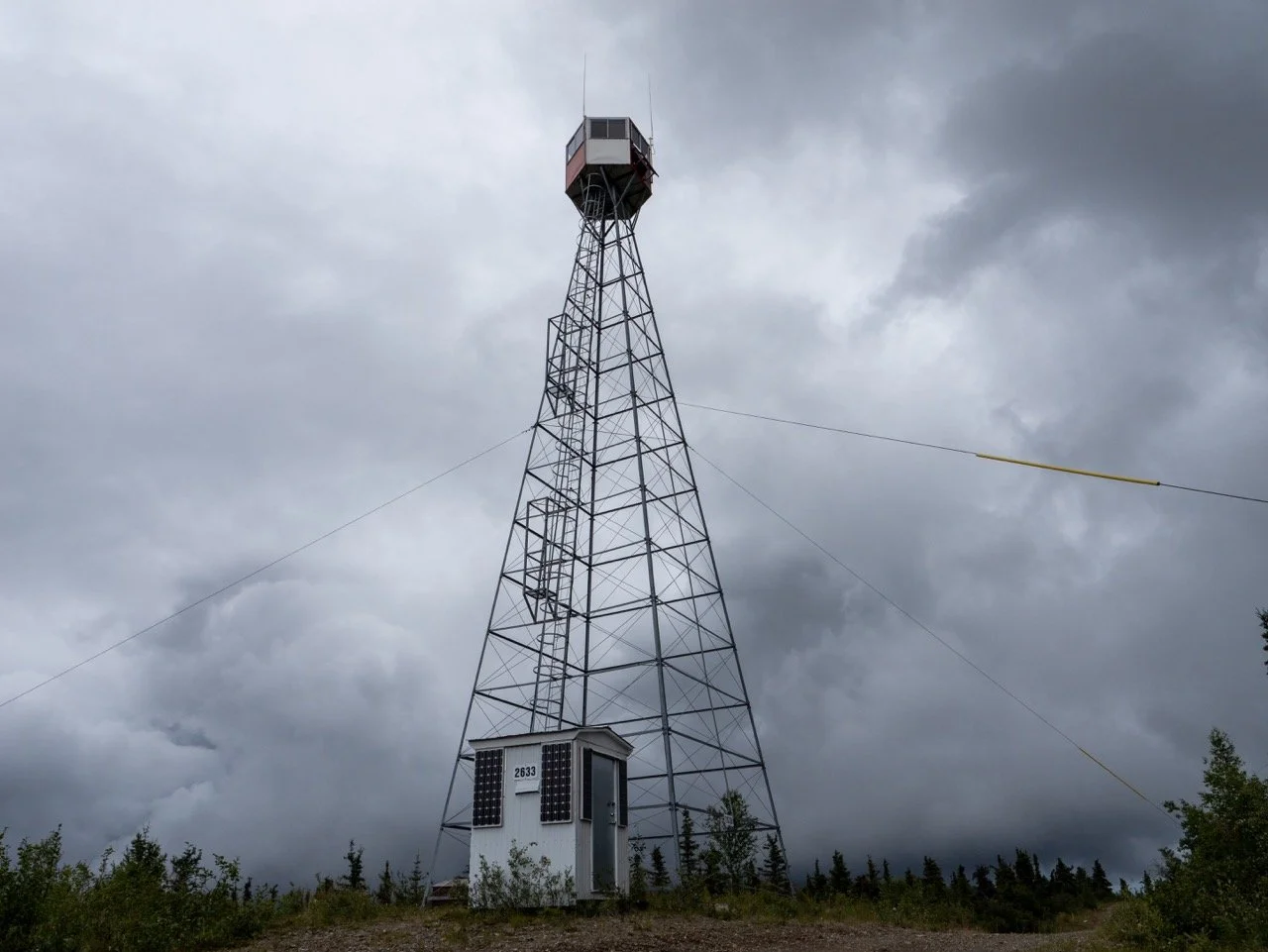
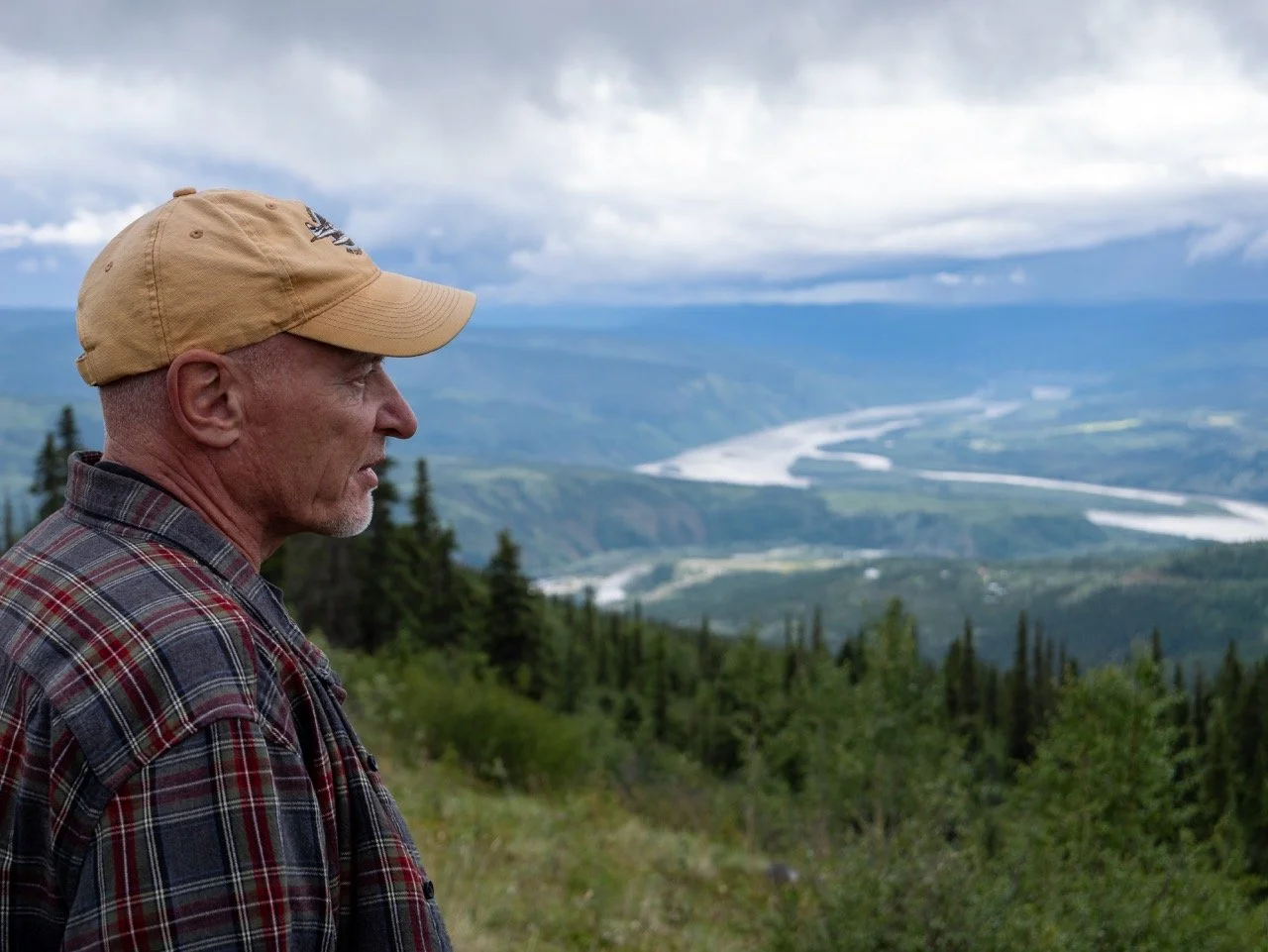
That’s where he spends most of his time—at the top of the fire tower. A steel structure anchored by guy wires, it’s topped by a “cupola.” The octagonal domed room is accessible via a caged vertical ladder, and offers 360-degree-views of the forest. It’s painted red and white. Years ago, the red faded to pink and the colour bugged Lenzin so much that he leaned out the window with extension paint rollers to give the cupola a face-lift. He used a mirror on a stick to check his progress in blind spots. I’m getting the feeling that this is what makes Lenzin such a good lookout—he’s meticulous.
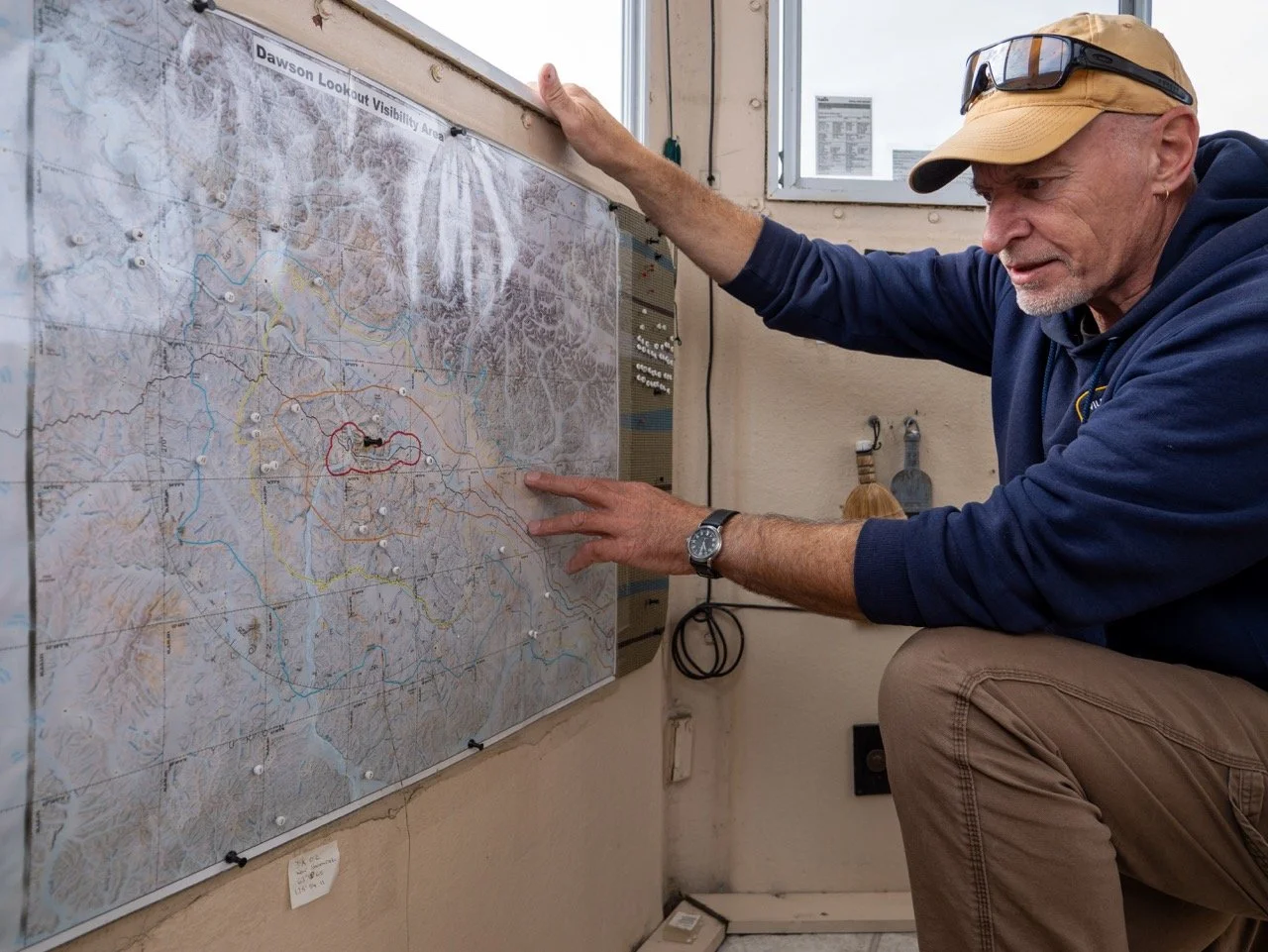
The cupola is clean and tidy. A logbook where Lenzin records his radio calls sits open next to the Osborne Fire Finder. Invented in 1915, the fire finder—a large 360 degree disc with a topographic map used for recording bearings on wildfires—remains one of the most essential tools at the lookout. It’s what Lenzin loves about his job: it’s low-tech.
When he spies what he thinks could be a smoke at the lookout, he verifies first with binoculars, then he spins around the fire finder and peers through the sighting hole to view the smoke through its cross hairs. He notes the degree on the graduated ring beneath the sight and gauges the distance of the smoke from the lookout. Then, he picks up the mic to his two-way radio.
Dawson Fire Centre, this is Dawson Lookout with a smoke in sight.
He passes his smoke report to the radio dispatcher: bearing, distance from the lookout, and the colour and behaviour of the smoke column. You can tell a lot about a wildfire based on the colour of smoke.
“The lighter the smoke, the less dangerous it is. A white smoke is a sign of a fire burning not too aggressively,” says Lenzin. “The darker the colour, the more aggressively the fire is burning.”
Black is bad. Black could be, say, a sauna burning—a fire that Lenzin spotted several years back—but Lenzin says there are hardly any ever human-caused wildfires in Dawson City. The majority are caused by lightning.
“The best part of the job is calling in smokes that [firefighters] catch and keep small,” says Lenzin. “My favourite fires are the ones that never make the headlines.”
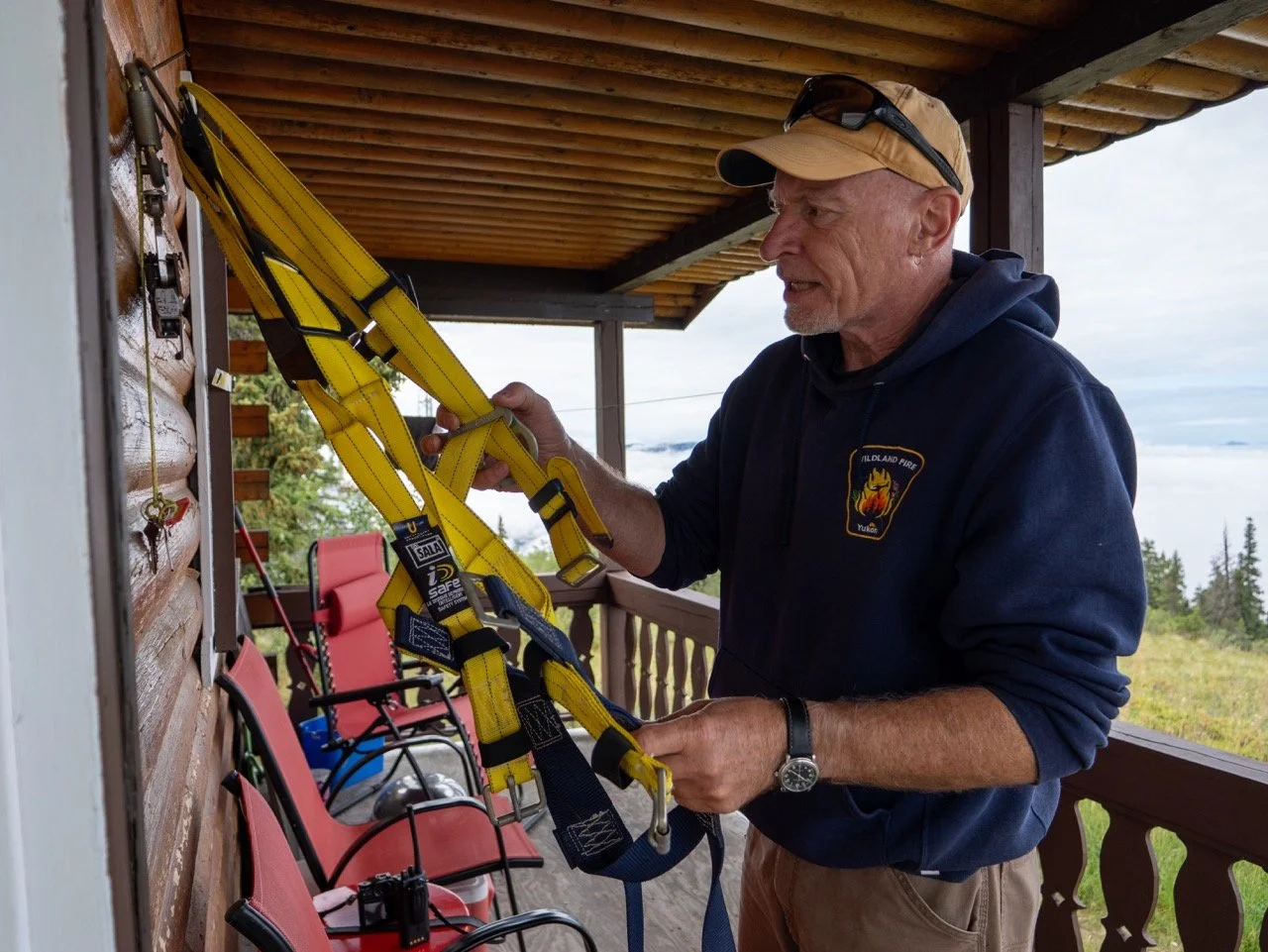
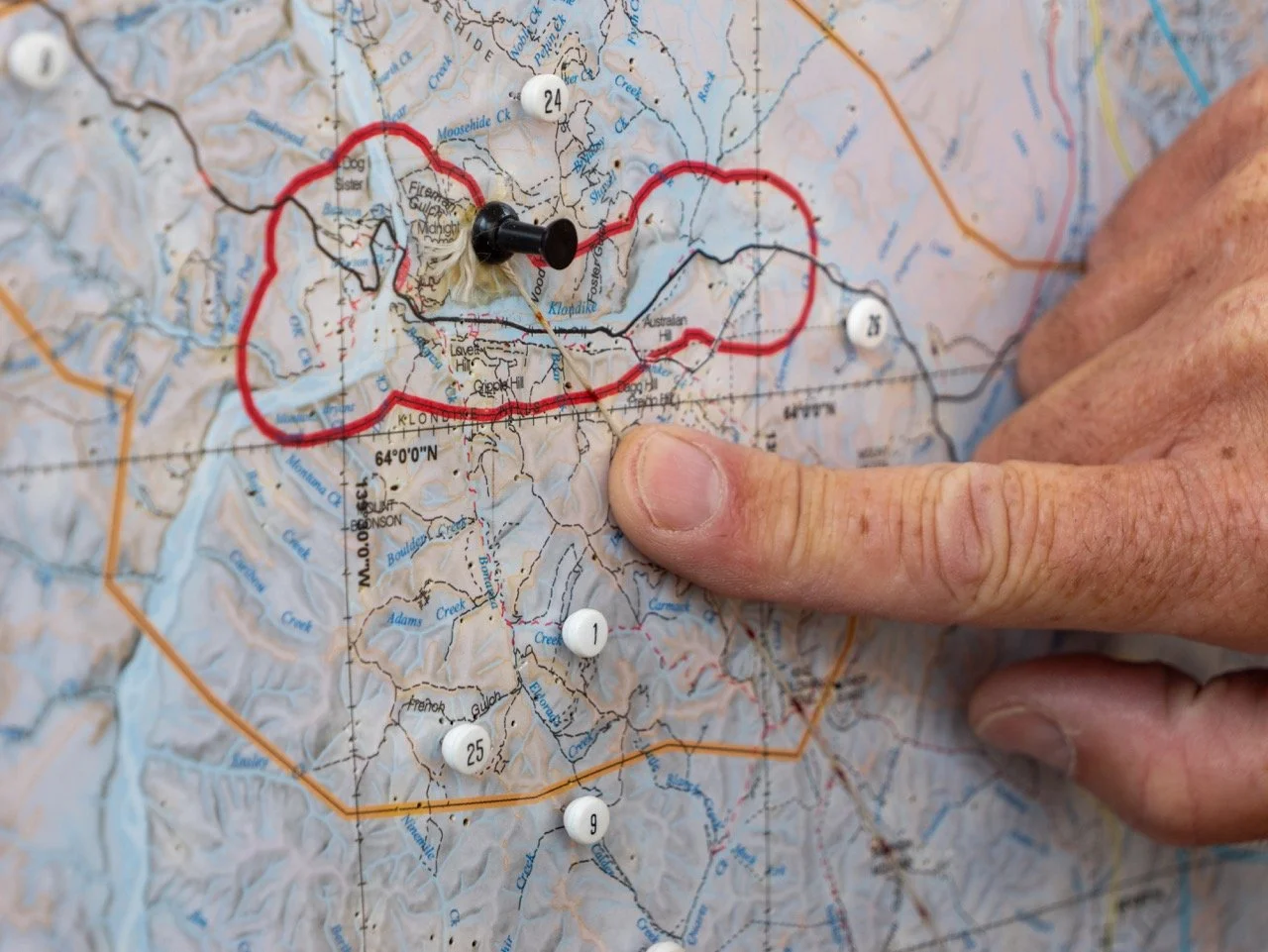
The season runs from May until August. Lenzin’s days are 12 hours long. On average, he detects six to seven wildfires in that time, but 2024 has been a record season for him. By mid-July he’s already at 12 fires. He caught two on June 26, including the Moosehide Creek Fire, which ignited after a bolt of dry lightning struck a tree, less than seven kilometres from his tower. “Too close for my taste,” he says.
As air-tankers dropped clay retardant and helicopters bucketed water on the open flames, the winds shifted and blew thick smoke down into Dawson City, prompting concerned calls from the public. Fortunately, crews managed to contain and extinguish the fire. Today, it’s a red scar on the landscape.
It’s hard to imagine what the scar might’ve looked like had Lenzin not detected it as quickly as it did. Minutes matter when it comes to wildfires. A single tree on fire can spread beyond 5 hectares—too dangerous for an Initial Attack crew to manage without additional resources— within 20 to 30 minutes, if the conditions are right. Given increasingly extreme weather events, including drought and high winds, the stakes for early wildfire detection have, perhaps, never been higher. It’s obvious that Lenzin feels that pressure. Sometimes he has nightmares about missing smokes.
“I think it’s easy to be a good lookout—if you care,” Lenzin says. “But also, you can care too much and give yourself a heart attack,” he adds with a laugh.
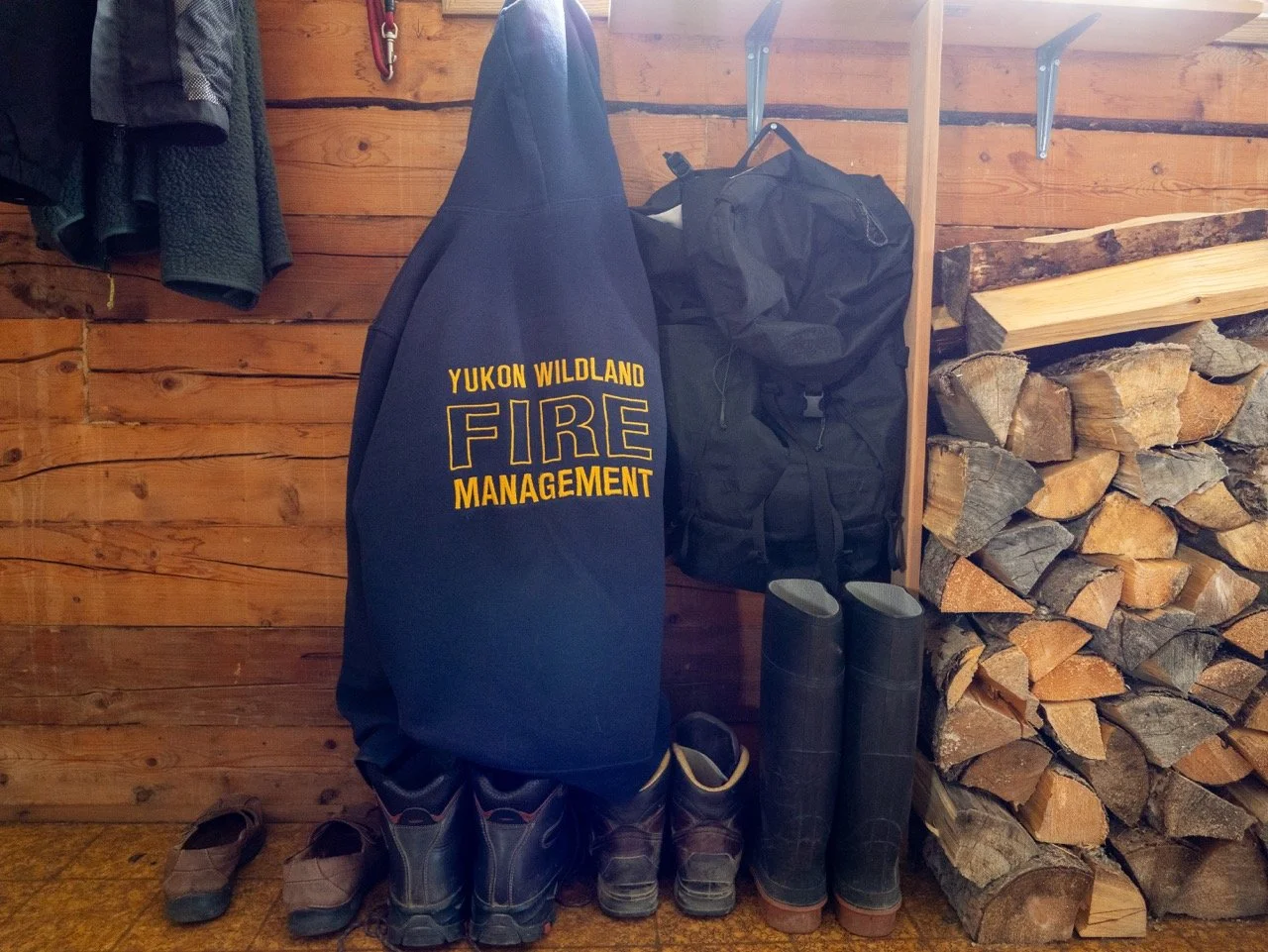
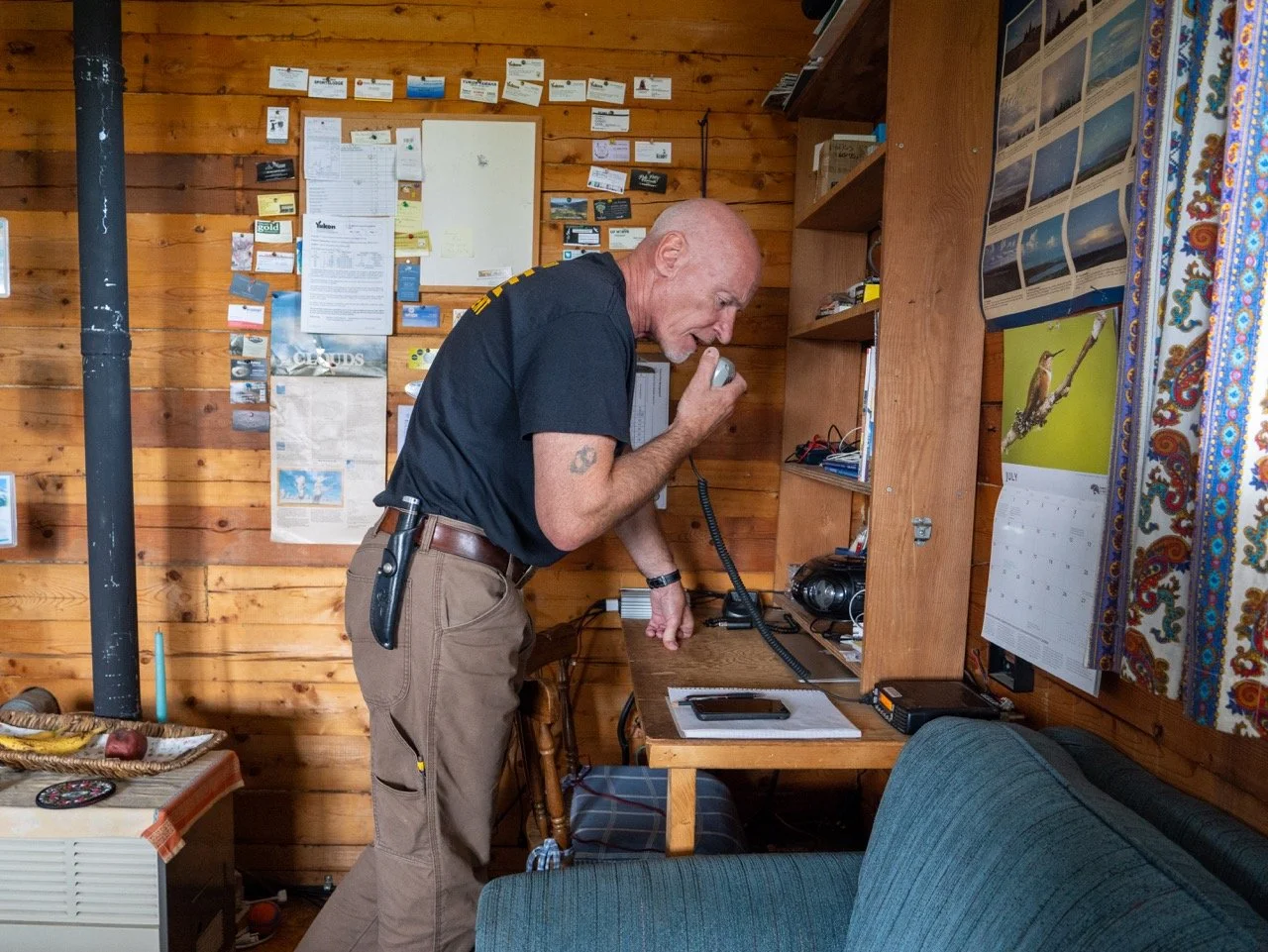
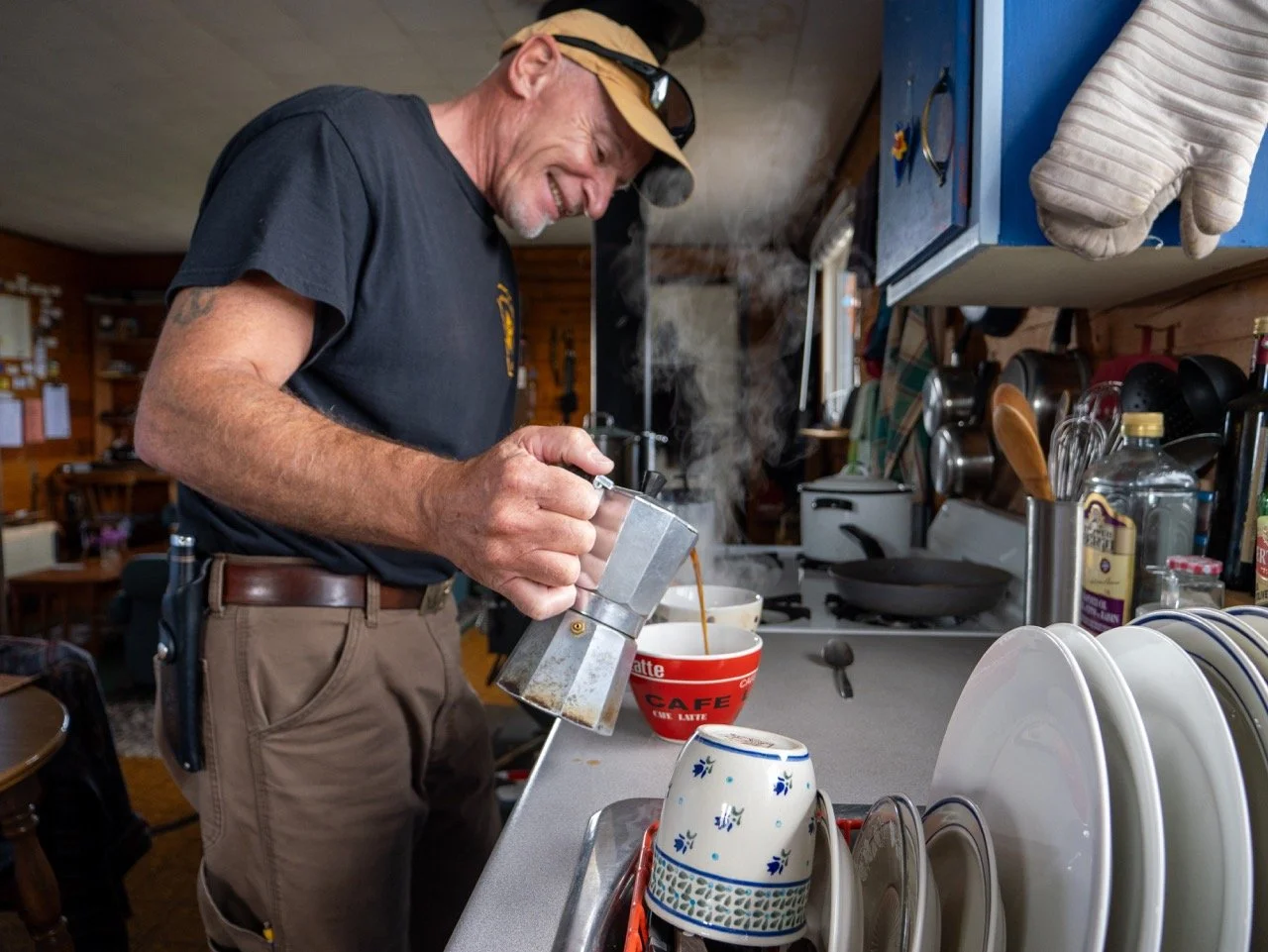
Down at the Dawson Fire Centre, crews play cards around a table. With the moisture and cooler temperatures, the risk of wildfires has dropped. But crews are always listening for the sound of Lenzin’s voice over the radio, Caylyn DeWindt tells me. She’s worked as a fire clerk in Dawson since 2011.
“If it’s a slow day, when people on base hear his voice, they’re excited for a fire,” she says. “When he calls in a smoke, [the location] is usually bang on, every time.”
Location accuracy is a skill that’s hard-earned over multiple seasons of memorizing a landscape. Often, only the most experienced lookouts are capable of such accuracy. In Alberta, they’re called “lifers.” Lenzin hasn’t heard the expression before, but he likes it. He’s the textbook definition of a lifer. He once called in a fire that was 200 kilometres into Alaska.
Guy Couture, a longtime Dawsonite, has been fighting fires in the Yukon since 1996. Today he’s probably one of the most experienced Initial Attack crew leaders in the Territory.
“If we see them small, we catch them small,” says Couture. “It’s when we don’t see them small and we can’t catch them … that’s what can cause major infrastructure damage.”
Couture cites a story about when Lenzin worked at Transport Tower, a decommissioned site in Watson Lake. He spotted a fire through a smoke column produced by burning garbage at the Watson Lake dump.
“He found a single tree on fire,” he says. “Seventy-five miles away.”
Stories like these are why Couture trusts his towers.
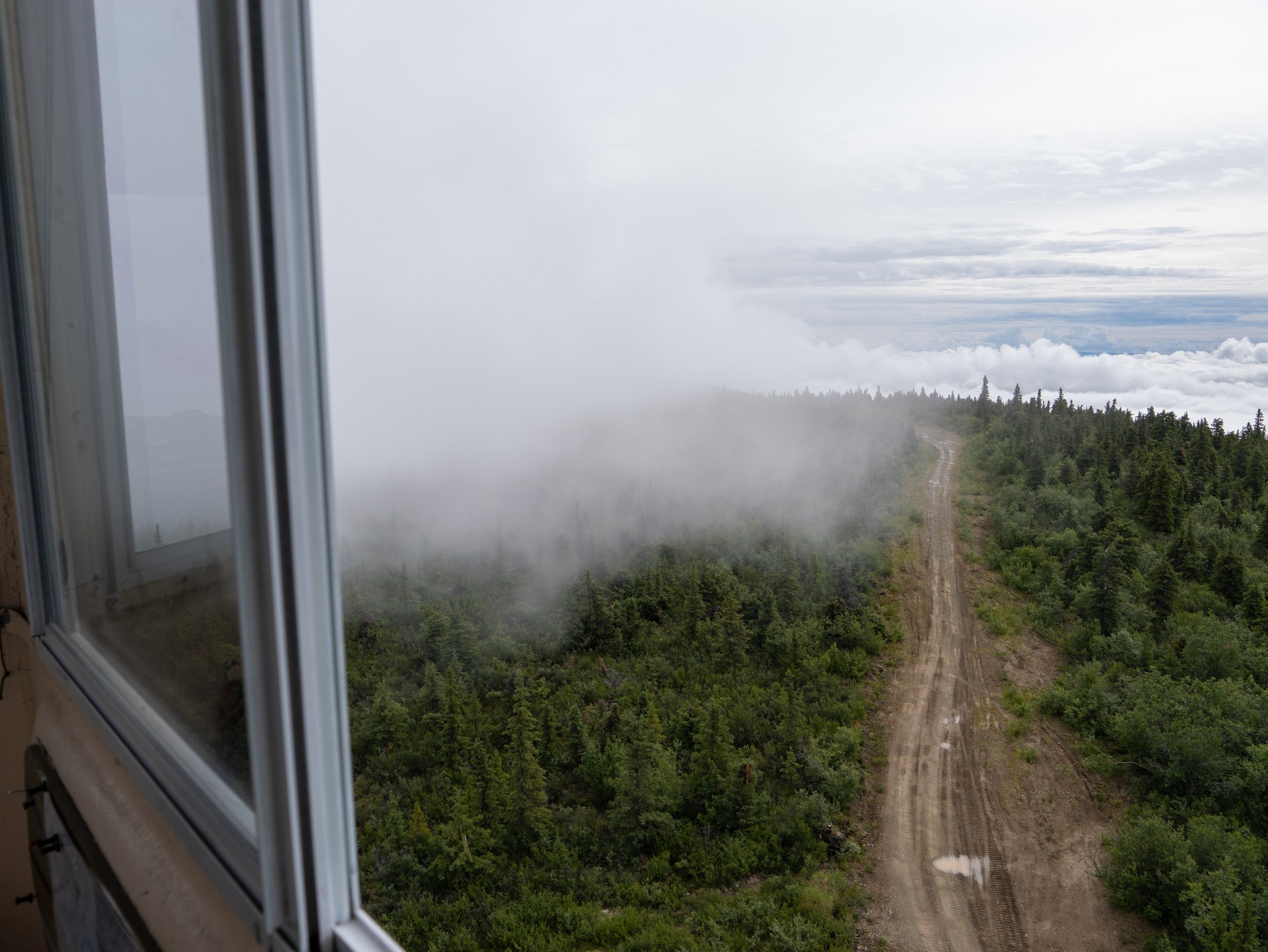
Fog pulls over Dawson Lookout like a blanket. (Photo: Trina Moyles)
On my last morning at Dawson Lookout, a blanket of fog conceals the valley below.
“Today we’re on green green alert,” Lenzin says, referring to the low fire hazard day. After a long stretch of days on red, or yellow alert (extreme, or high fire hazard), the fog is comforting to him. On days like today, he reads books, splits wood, and repairs the cabin.
“It’s bliss,” he says.
Lenzin doesn’t experience loneliness at the lookout. He finds he’s lonelier in cities than in the bush, a place where he feels safe. “I feel that I belong when I’m in the bush. In the city, I always feel like an outsider,” Lenzin says. But too many rainy days in a row and he’s eager to get back up to the cupola. The best part of the job is spotting fires.
Later that afternoon, the hot sun burns off the fog. Lenzin casually points out a tiny smoke burning across the river in the agricultural community of Sunnydale. It’s likely a campfire, he says. It’s so minuscule that I have to use binoculars to see it.
“How the heck did you even see that?” I ask, though I know that it’s the result of 13 seasons staring at this land. And he’s not done yet. Lenzin won’t retire until he’s detected 100 wildfires, he says. By mid-July, he’s at 80.
“At the end of every season, I’m just grateful no communities have been harmed and I’m just as grateful that no accidents on fires have occurred.”
He’s dedicated to his job of keeping communities and crews safe. It’s the main reason he returns every season, to soak up the camaraderie of working with firefighting personnel, but also the solitude of playing witness to weather and the beauty of the natural world around him.
Before he drives me back to the airport, a brilliant rainbow appears against a storm-stained sky.
“It’s a good lookout omen,” I say to Lenzin and he laughs.
We know one when we see one.
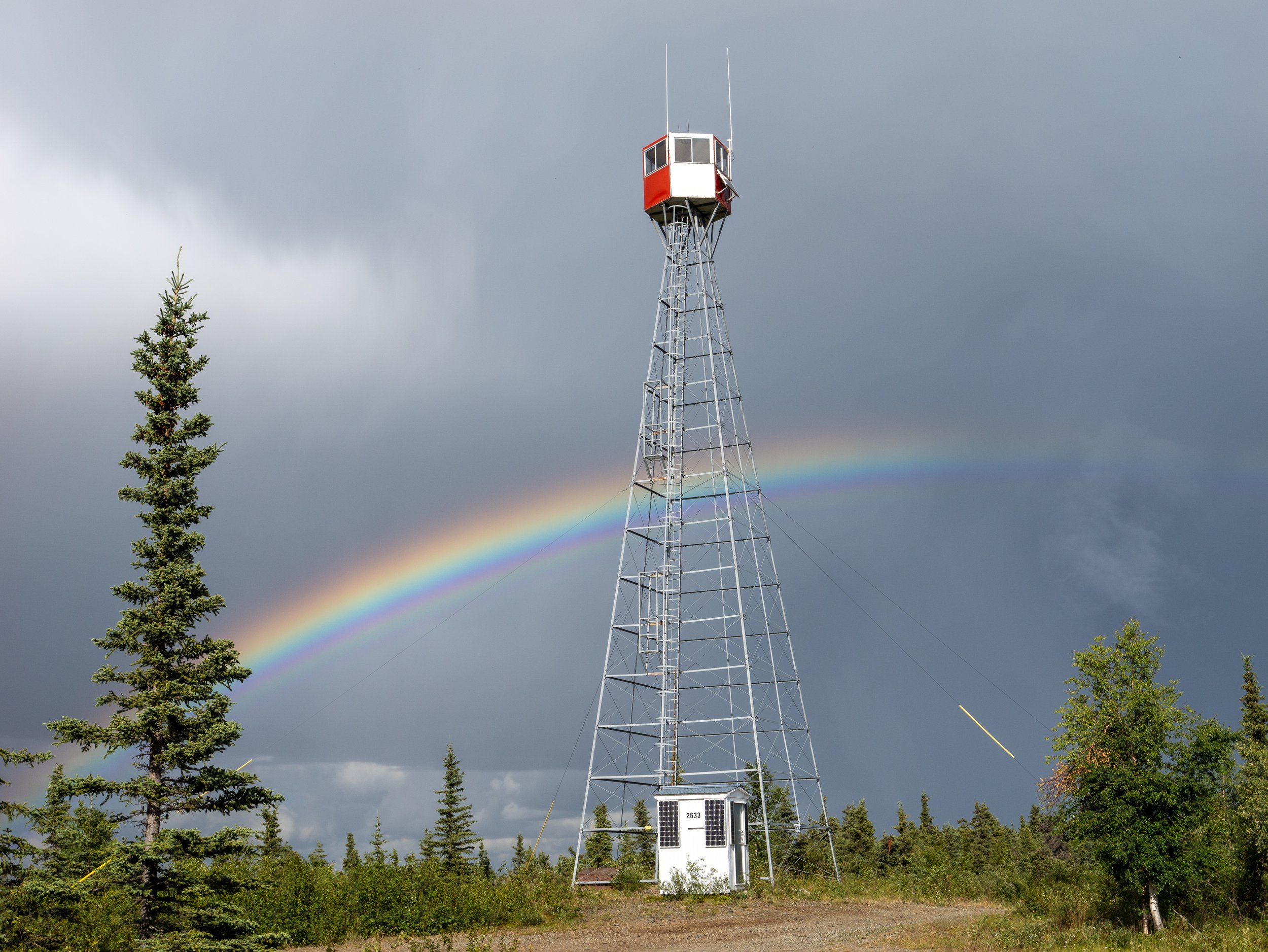
A good omen on my last morning at Dawson Lookout in July 2024. (Photo: Trina Moyles)
Post-Script:
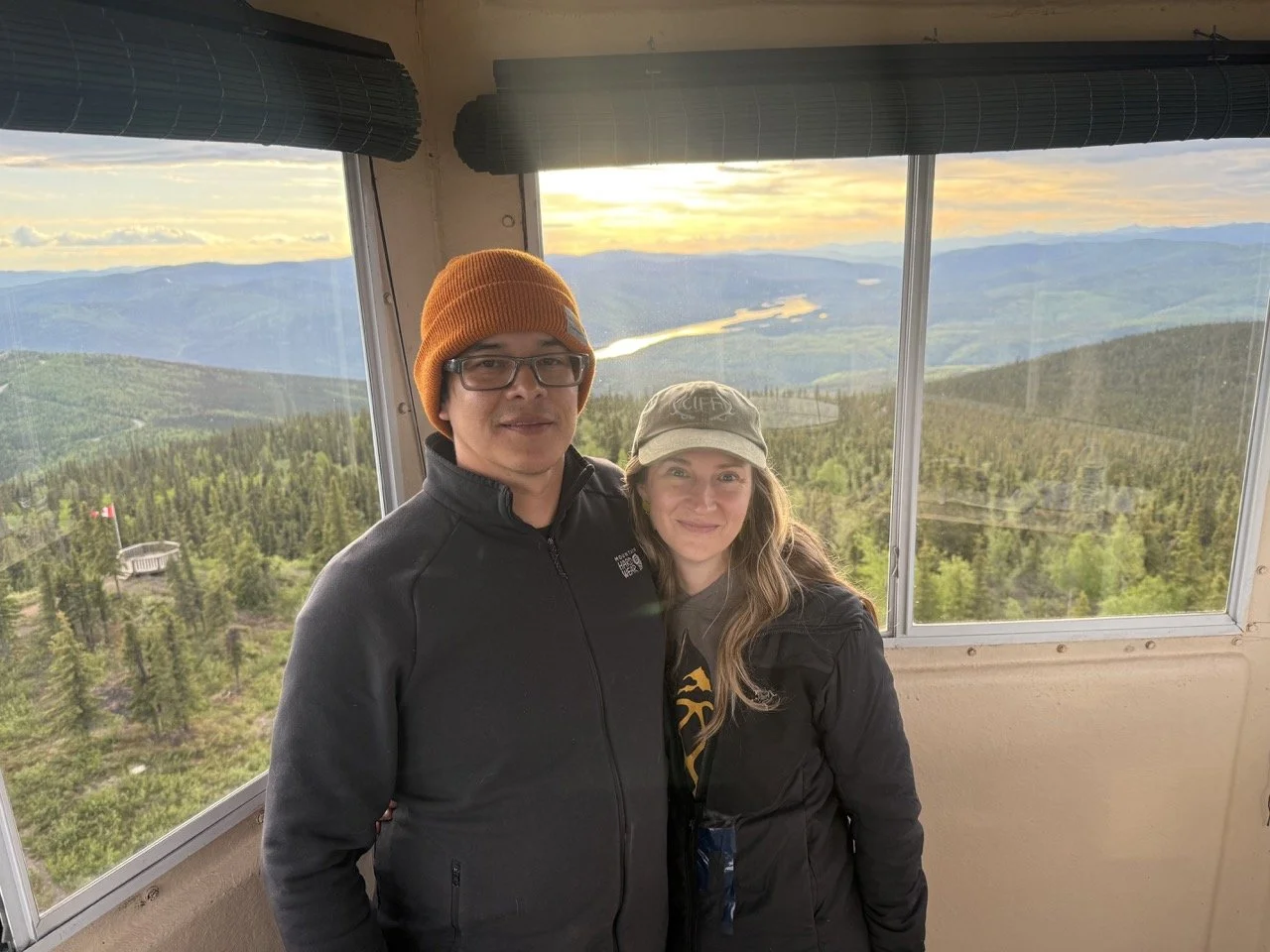
Last week, I traveled up to Dawson with my beloved fire tower dog, Holly. We spent a week camped out beneath the lookout, enjoying time visiting with Markus and Elfie. I climbed up to keep Markus company (and perhaps, provide some entertainment, ha!) as he kept vigil for smokes. Other than some kind of mining equipment putting up a tiny smoke in Bonzana Creek, we didn’t see any action. Regardless, it was a beautiful visit. My partner Mike was in Dawson to work on an unrelated film project, so he also had to opportunity to climb the tower and get a taste of lookout life.
Two days after we arrived back in Whitehorse, I got a text from Markus. They’d had a smattering of lightning strikes and he’d called in two lightning fires. By end of the day, he’d caught another two.
It’s safe to say that Markus will surpass his goal of calling in over 100 wildfires in his lookout career. And yet, we both know, it was never really about numbers. The job is all encompassing.
The truth is that once you’re a lookout, you’ll never stop watching the clouds, or reading the forest conditions for fire hazard. Even long after Markus retires, I know he’ll be watching for the slightest hint of smoke, that particular bluish-white shade — such a satisfying colour to a lookout — to curl and rise.
Once a lookout, always a lookout.
Thanks for reading, friends!