Recreating With Dogs in Bear Country
coexistence depends on how we manage the animals at our side
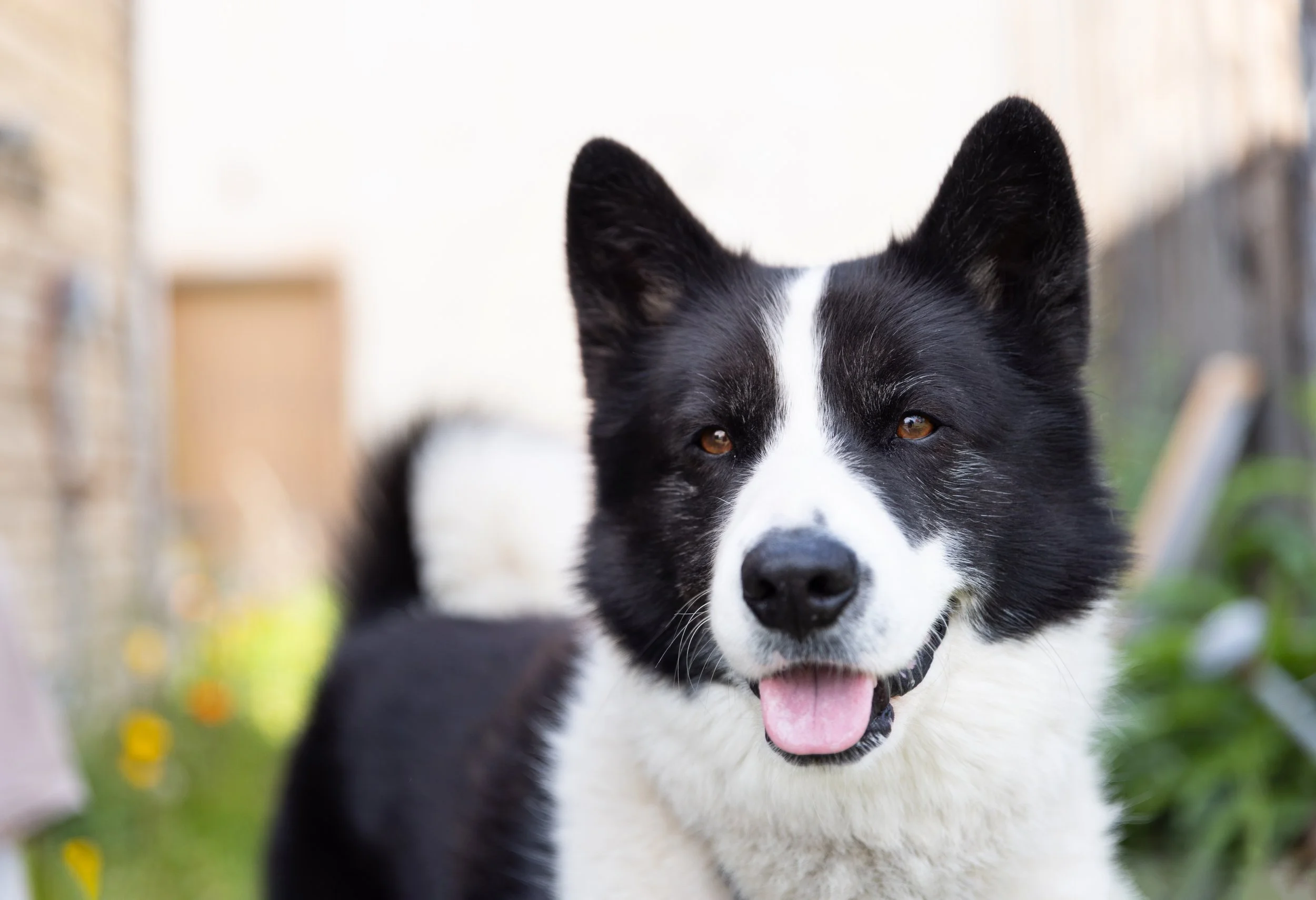
Willie, a Karelian bear dog. (Photo: Manu Keggenhoff)
This article was originally published as “So You Think You Have a Bear Dog?” in The Yukon Magazine in Fall 2025. It has been amended to reference more recent events.
Last April, a post on Whitehorse’s community Facebook page caught my eye. It was written by a concerned citizen who’d watched an off-leash dog chase two black bear cubs up a tree in the Hidden Lakes area, close to the Riverdale neighbourhood.
“The bears are now out [of their dens]. Please put your dogs on a leash,” the post read.
As a trail runner and owner of three large-breed dogs, I made a mental note—it’s that time of year again—and reminded myself to get the bear spray out of storage.
However, as an author who’s been writing a book about black bears over the past several years, the post also stuck with me in a more philosophical way. I took to the forested trails with my own pack of three dogs, contemplating the ethics of recreating with my four-legged companions in the wilderness. Whether they chase a ground squirrel, spruce grouse, or bear cubs, it’s hard to deny the fact that dogs do have an impact on wild species trying to survive.
How would my dogs react if we crossed paths with a black bear, or grizzly bear? Would they bark, hold ground, or chase? Of my pack of three, Holly—my fire tower dog—is the only one whom I’d say has legitimate recall, which she’s consistently proven in past bear and wildlife encounters. However, Holly is now 17-years-old: she’s almost entirely deaf.
The other two dogs are less experienced with bears, although I’m fairly confident that Sofie, the Siberian husky, would delight in giving chase to one. Kenai, our confident Alaskan husky, has decent recall, although last spring (much to my horror) he chased an elk and her calf. Maybe Kenai would think twice about chasing an adult bear, but a tiny cub scampering behind her mom? Game over.
Maybe you’re like me, constantly grappling with the tension between coexisting with bears, and recreating with dogs on the land. While I have my own ideas, and past experiences with dogs in bear country, I felt motivated to dig a little deeper into the story of bears and dogs, and dogs and bears, and so-called “bear dogs”, too.
I wanted to speak with different local experts who specialize in bear and dog behaviour and ask them: How do dogs factor into human-bear coexistence? What kind of dog behaviour is ideal in an encounter with a bear? What makes a good bear dog?
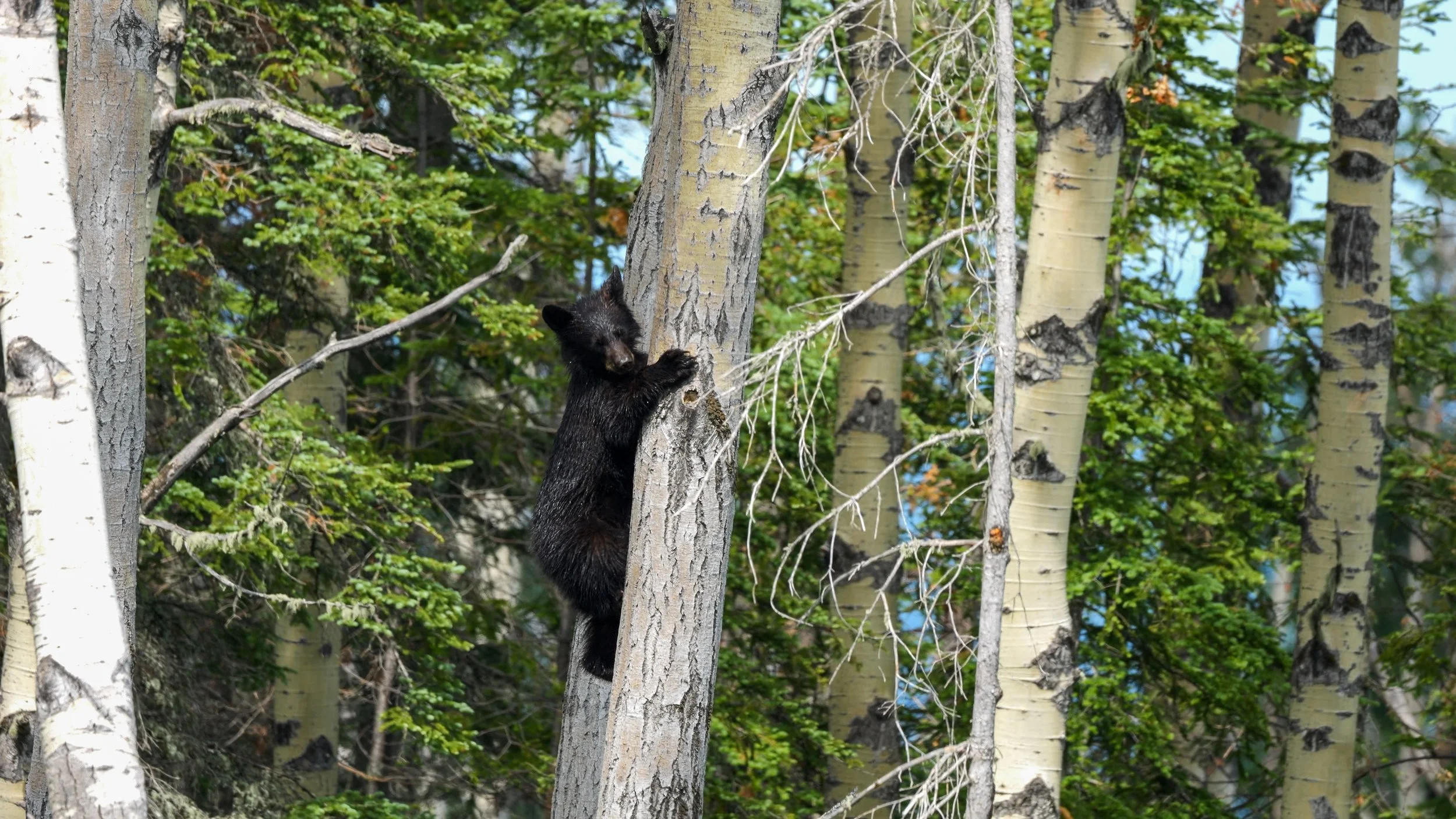
Black bears, especially cubs, have evolved to flee in threatening, or dangerous situations. Research by Stephen Herrero in 2014 found that of 92 reported black bear attacks —49 incidents involved dogs. (Photo: Trina Moyles)
Our canine companions can be an advantage out on the land, says Adam Henderson, who’s worked as a conservation officer with the Yukon Government over the past 10 years. Equipped with olfactory abilities far superior to our own, dogs smell bears and other species when they’re around and can tip us off early. A dog sniffing the air, or ground; ears perked; fur lifting on the dog’s spine; a low growl, or sharp bark. These are cues we can pay attention to that signal a bear is around. But it’s a double-edged sword, says Henderson. While dogs can help people avoid encounters, they can just as easily trigger or escalate defensive behaviour in bears.
“When your dogs are off leash, you have to be well aware of the risks you’re taking,” he says. Every summer, the Yukon Government fields calls about dogs running ahead of their owners and surprising or displacing black bears and grizzly bears in the Whitehorse and Southern Lakes areas.
“Dogs, especially off-leash, can increase the unpredictability of an incident,” he says.
Bears aren’t the only concern either. This can also happen with a mother moose and calves, coyotes, fox, and wolves. Every year there are cases of off-leash dogs preying on newborn moose calves, whose mothers often try to hide them in the forest as they forage. Even when dogs are leashed, it’s not a guarantee they won’t react in a way that triggers a bear to respond defensively, says Henderson.
“Maybe they’ve never experienced an interaction with a bear, and they pull the leash and take off. You have to accept the risks that could occur.”
Only two weeks ago, a man who was out walking his two unleashed dogs on his rural property in Vanderhoof, B.C. , was attacked by a grizzly bear. The man crawled behind a barbed wire fence—the bear disengaged and ran off. Conservation officers called it a “defensive attack”.
Research by Stephen Herrero, an ecologist and the author of Bear Attacks: Their Causes and Avoidance, found that of 92 reported black bear attacks, 49 cases involved dogs. Herrero has referred to dogs as “wild cards” in bear country.
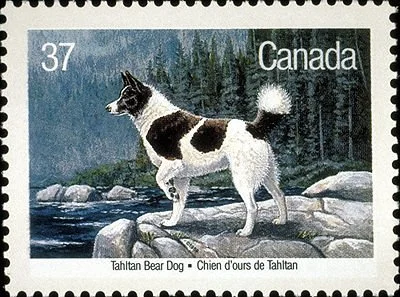
Indigenous peoples used the Tahltan bear dog in sustenance hunting— primarily for bear. (Image from the Canadian Encyclopedia.
“My dog is a bear dog mix”—Michelle Wieser and Jenn Stellbrink hear it from Yukoners all the time. Wieser and Stellbrink are dog behaviour specialists who run the dog training company, Wise Canine. They say people usually base their bear dog claims on appearance alone. Typically, it’s a smaller, fluffier and “yappy” dog, says Wieser, resembling the Tahltan bear dog, a breed that’s indigenous to First Nations in northwestern British Columbia and the Yukon, including the Tahltan, Tlingit, Tagish, and Kaska.
The Tahltan bear dog was bred for sustenance hunting of many species, including bears. The dogs were small, feisty, and light enough to run across the hard-crusted snow. Some hunters would carry several dogs in a sack to conserve their energy, then release the dogs who’d locate the bear, bark relentlessly, and surround it until the hunter arrived.
There are other bear dog breeds, too, including Karelian bear dogs, native to Finland, and Norwegian Elkhounds, which were also bred to track and hunt bears.
Bear dogs (amongst many other dog breeds) have been bred to respond to what behaviourists refer to as “sudden environmental contrast,” says Wieser. When wildlife appear in a quiet forest—be it a snowshoe hare, moose, or bear—dogs react by barking and chasing away the perceived threat. Other breeds, including terriers and schnauzers, which were bred for hunting rodents, are likely to respond in a similar way.
Unfortunately, Weiser points out, that kind of reactive genetic behaviour in dogs is exactly what could trigger a defensive bear attack. It’s the behaviour we don’t want in the modern context of recreating on trails around Whitehorse or hiking the Yukon backcountry.
“Most people don’t have the kind of recall on their dog that’s necessary to be able to call them off [a bear],” Stellbrink says.
Stellbrink owns two Elkhound bear dog mixes named Blitz and Donner. With her dogs’ genetics in mind, she’s trained extensively for recall using long-line leashes of up to 30 feet in length. The long-line grants dogs more freedom than a short leash, while still giving the owner the ability to rein the dog in, if they don’t respond to recall. She does additional work with her dogs, trying to re-condition their emotional responses so that, even when they come across ‘novel’ things in the wilderness, including bears, they will quickly refocus their attention on her.
“We want the dog to remain connected to us [in a bear encounter],” explains Wieser. “We want to be able to call them away and focus on us. The ideal goal is to leave the bear alone.”
If that’s too big of an ask—which it often is in a bear encounter—the trainers recommend using a long-line, or leash, which helps to keep the dog, human, and bear safe.
“It’s a lot to rely on a dog to make the right choices when they encounter any kind of wildlife, let alone a bear,” says Weiser, pointing out that the same instinctive chase behaviour is what results in many dogs getting (sometimes fatally) quilled by porcupines in the Yukon.
What’s key for safely recreating in bear country is that people train their dogs—regardless of breed—to react in a way that allows the owner to remain in control of the dog.
“People feel strongly that their dogs are protecting them,” says Wieser. “But if a dog is reacting in a big, defensive way they’re often protecting themselves, and they’re saying to us, ‘you’re my person, help navigate this for me.’”
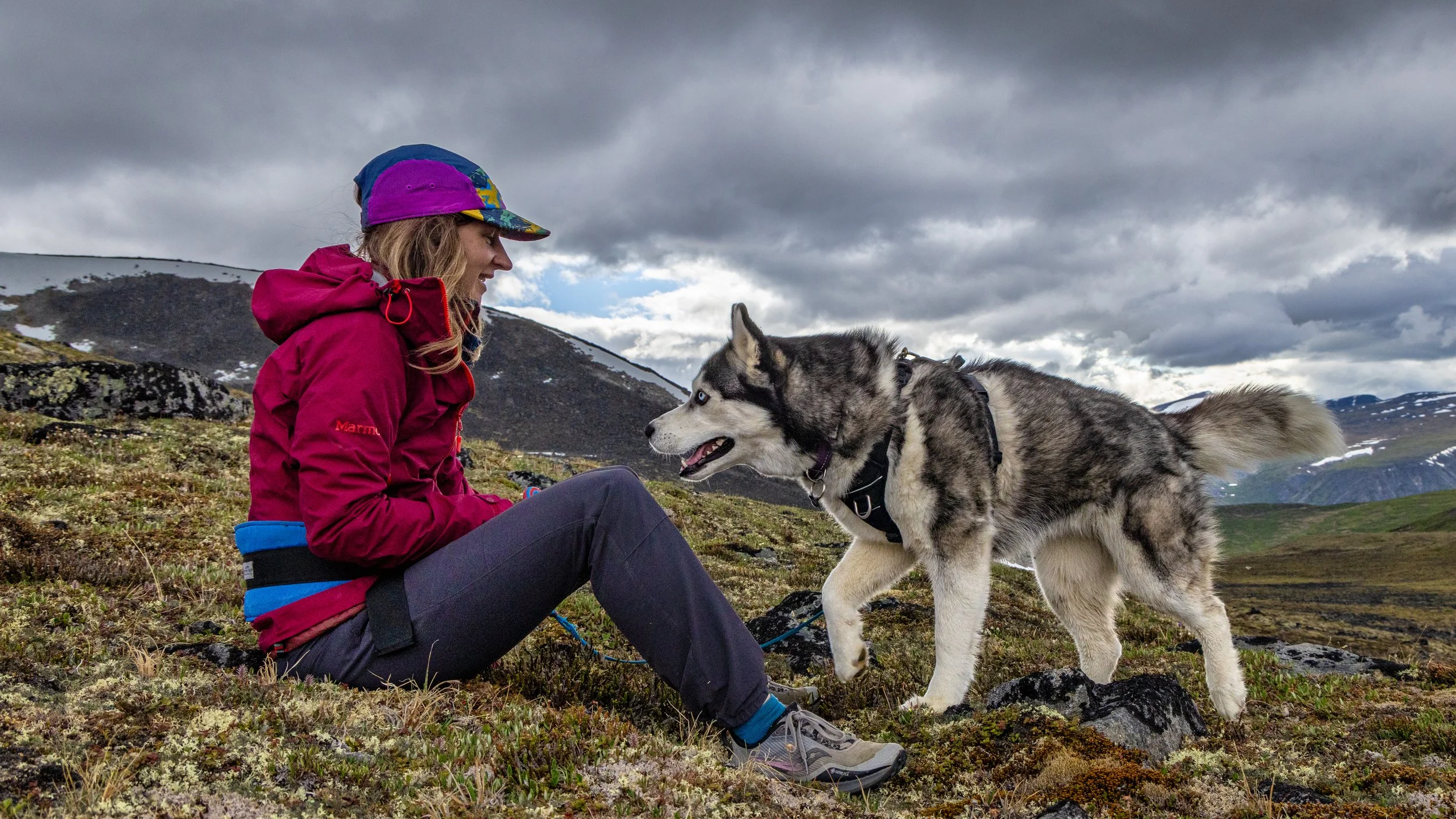
The author and her Siberian husky, Sofie, on Kusawa Ridge. (Photo: Julien Schroder).
That’s the relationship Phil Timpany has had with a number of bear dogs over his years as a grizzly bear viewing guide along the Taku River, near Atlin, B.C. and in northern Yukon. Timpany has spent 45 years observing bears at close proximity, accruing upwards of 4,000 days viewing bears along salmon runs in northern B.C. and the Yukon.
“A dog is your best friend, but a bear dog is more than that,” says Timpany. “He’s a colleague and a teammate.”
Over the years, Timpany has trained three different Norwegian Elkhounds to aid in his work as a guide and maintain a safe, relaxed space with people and grizzly bears. In Timpany’s case, that’s meant training a dog to feel comfortable in the presence of bears at very close-range. Remarkably, his Elkhounds—historically bred to hunt bears—are trained to follow Timpany’s lead and react only when a bear crosses a line. His current dog, Tucker, was named after a female grizzly, of whom Timpany was particularly fond.
Timpany trained Tucker by gradually exposing him to bears and reassuring the dog that their encounters are routine and not a reason for anxiety and stress. Bears are pretty good-natured, says Timpany. They’re also, like many wild animals, cognizant of saving valuable energy.
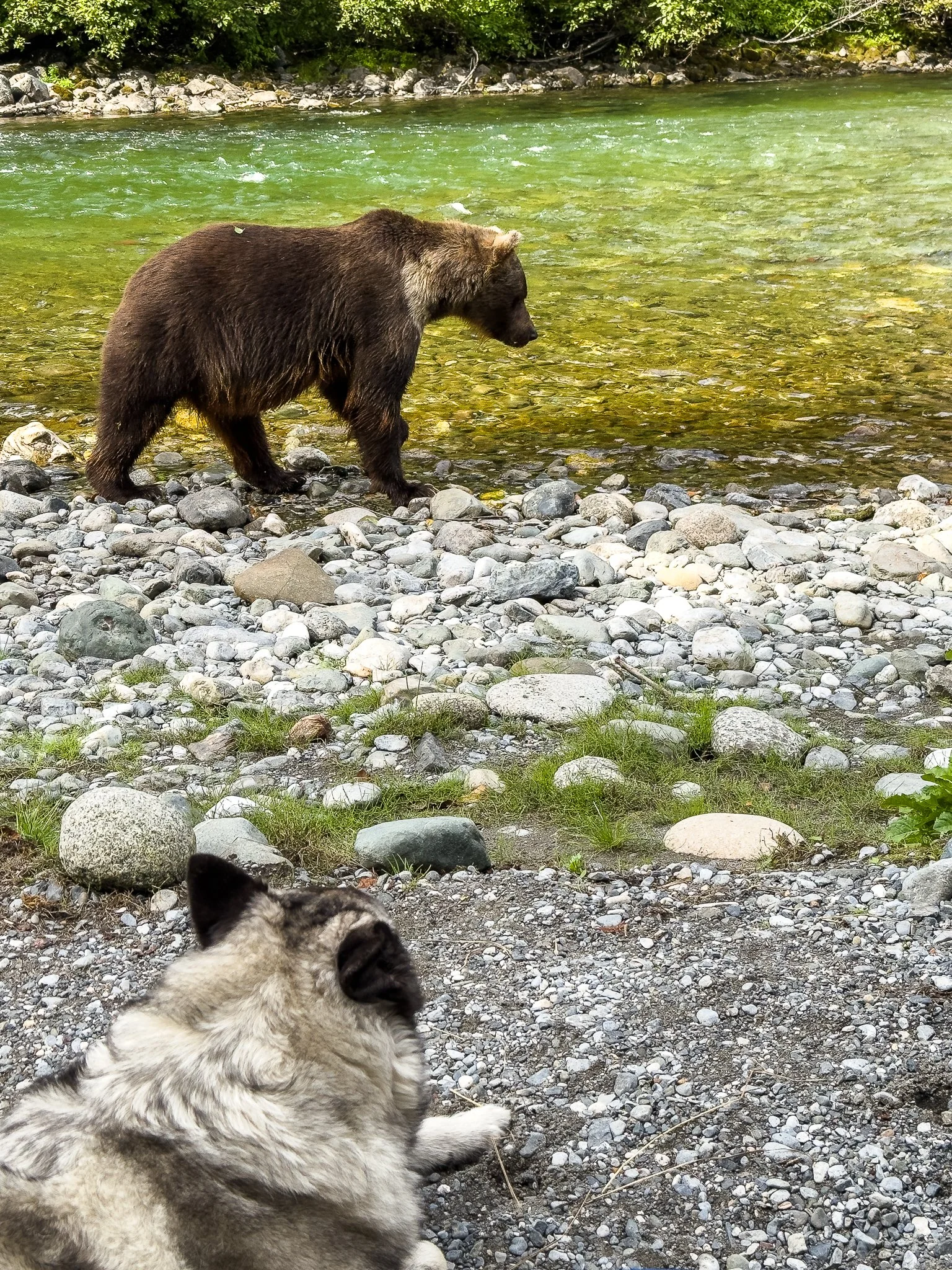
Tucker, an Elkhound, calmly watches a grizzly bear wandering by. (Photo: Phil Timpany)
There’s that saying that ‘bears hate dogs’, but Timpany doesn’t think that’s necessarily true.
What bears dislike is unpredictable behaviour. It isn’t easy being a bear in a world where domestic dogs can react in a range of different ways. When a bear has a negative experience with a dog—a dog chasing its cubs, for example—it puts them, rightfully, on edge. Timpany uses body posturing with the grizzly bears to neutralize any fear, or tension, and has trained Tucker to do the same. The dog—never on all fours, which is an aggressive stance to the bear—sits, or lays down, which signals to the bear, “I am not a threat.”
For Timpany, what makes a good bear dog is actually an owner that understands bear behaviour and remains in control during an encounter.
“People think that the dog needs to be aggressive in order to get you through a bear encounter, but the worst thing you can do is make the bear believe that you’re the enemy.”
Timpany recommends that people leave their dogs at home when recreating in bear country, knowing that most dogs aren’t trained to Tucker’s ability. Otherwise, leash your dog. If you encounter a bear, speak gently to the bear, calm your dog, and give space.
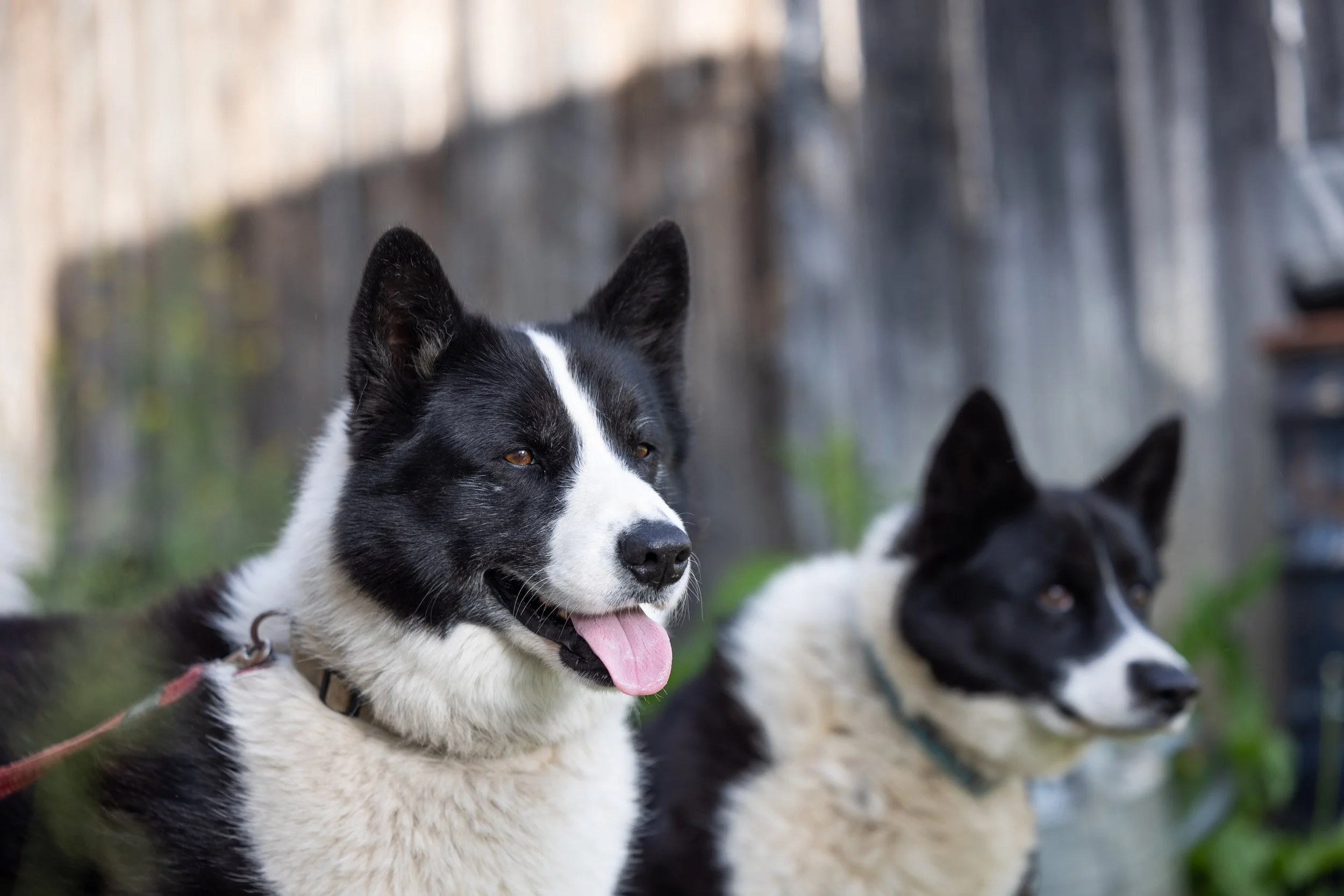
Karelian bear dogs were bred to hunt and track bears, but today, they are often trained to keep bears at bay for environmental research purposes. (Photo: Manu Keggenhoff)
Oddly enough, as I was working on this story about bear dogs, a black and white dog named Finn trotted over to my table at a Whitehorse cafe and sniffed my pant leg. I immediately recognized Finn’s arrow-shaped ears and tightly curled tail.
“Is that a Karelian bear dog?” I asked his owner, Dave Poitras, who confirmed my suspicion and started a conversation about Finn and his breed (it turns out, Karelian bear dogs aren’t so much food-motivated as they are experience motivated—visiting the dog-friendly coffee shop is Finn’s weekly reward for good behaviour).
Poitras, originally from Newfoundland, moved with his wife and daughters to Whitehorse in 2017 to work as a paramedic. His family quickly fell in love with recreating in Yukon’s backcountry, but Poitras admits he soon learned that “everywhere is bear country,” even the playground at his daughters’ school in Whitehorse.
After encountering a Karelian bear dog while on a hike in 2020, Poitras began to research more about the breed. In a modern context, Karelian bear dogs can be trained to maintain a safe space between people and bears. The Wind River Bear Institute in Alaska, for example, breeds and trains Karelian bear dogs to help biologists avoid grizzlies and black bears during conservation or environmental fieldwork.
Poitras brought home Finn as a puppy in 2021 from a breeder in Whitehorse. He admits that, despite Finn’s loyal demeanour to his family, training the intelligent, headstrong bear dog has been “a battle of wills.” Karelians are a “working dog,” says Poitras, and they’re constantly alert for threats. That’s meant training Finn to be relaxed around other people, dogs, and children.
“You have to be very disciplined in your training efforts otherwise [Karelians] can be a problem,” says Poitras. “If you don’t have that capacity, don’t get one of these dogs.”
The paramedic has worked hard to train Finn to respond and recall to both his voice and hand signals. He’s noticed some of Finn’s genetic instincts with bears. As a puppy, he naturally wanted to “play bear.”
“He barks at me and wants me to go after him, then I’ll playfully lunge at him and he’ll run around me in circles, barking and harassing,” says Poitras.
It’s taken time to build trust with Finn’s ability to recall in the backcountry and Poitras admits, he’s the only one in the family who can walk the dog off-leash. While hiking, Finn will run wide loops, circling around Poitras to make sure everything is safe in all directions.
Finn has never had a face-to-face encounter with a bear, but Poitras once observed a sudden change in his hyperactive behaviour. The dog stopped, and didn’t bark, or growl, but made a low wow, wow, wow sound. Poitras suspected a bear was nearby.
Even with Finn, Poitras knows you can never rely on a dog alone to stay safe in bear country. He still carries bear spray, bear bangers, and makes a lot of noise when hiking. It’s his responsibility too.
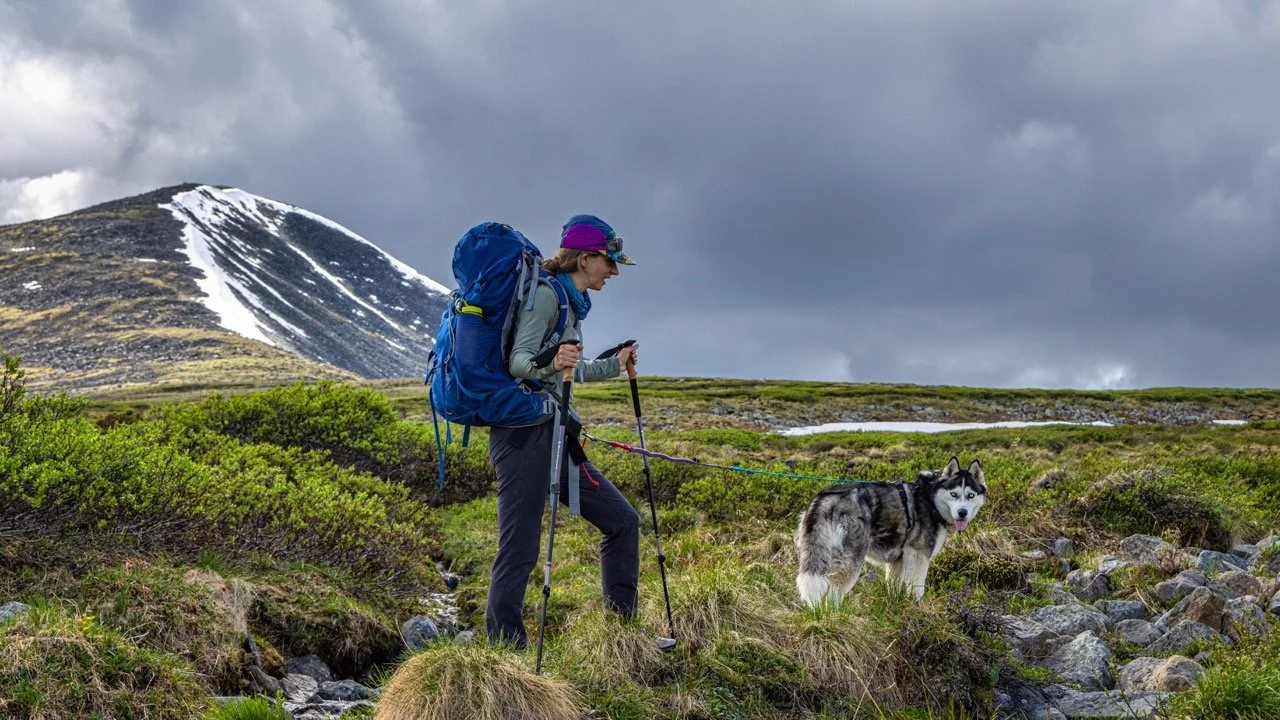
Keeping your dogs on a leash, or long-line, in bear country is one of the kindest things you can do for wildlife—and for your dogs. (Photo: Julien Schroder).
That’s why another critical aspect of recreating in bear country with dogs is knowing where bears are on the landscape and understanding what’s at stake for them. In early spring, they’re out looking for green up of sedges and plants, often on south-facing slopes. In June, it’s bear mating season and they’ll be out and about in courting pairs. Come summer, the blueberries and cranberries ripen along the trails where I run with my dogs everyday. In fall, they’ll burrow beneath the ground for the winter. Before that happens, their bodies undergo hyperphagia, an extreme metabolic need to feed, to pack on vital pounds.
Knowing more about bears invites us to consider how we can adapt our own behaviours—and manage the behaviours of our dogs—when being on the land.
On every walk or run with my dogs, I take great care. I choose wide, open trails with greater visibility where we’re less likely to surprise a bear. I carry bear spray. I make noise. I practice and reward recall with my dogs. I train them to look to me for direction.
I also like to think of the words of Yukon writer, Anna Tupakka, who wrote eloquently in an essay about training her puppy for nonreactivity that “the backcountry should not be treated as a doggie playground. Wilderness areas are for the wild. As much as we might want our dogs to run as wild and free as wolves, they are, like us, only visitors.”
As I run, I consider my responsibility as a dog owner to tread as lightly as I can, without taking bears, and the beautiful lands we both inhabit, for granted.
A video of the ‘Hidden Lakes bears’, a cinnamon phase black bear, habituated to the Grey Mountain area in Whitehorse, crossing the road with her three tiny cubs in April 2024…also a reminder for vehicles to SLOW DOWN in bear country!
STAYING SAFE WITH YOUR DOG IN BEAR COUNTRY
Carry bear spray where it’s easy to quickly access;
Research areas in advance where you plan to recreate for any reports of bears, particularly, mothers with cubs;
Ensure your dog is on a leash, or long-line;
Keep vigilant for signs of bears, including tracks, scat, rub trees, hair snags, etc;
Be mindful of the season and location: early green-up in spring, mating season in June and July, berry season in August;
Practice and reward recall with your dog on a long-line to prepare for encounters;
On backcountry camping trips, store all human and dog food in a bear-proof container and cache away from your campsite;
In a close encounter with a bear, keep your dog close to you, reassure them, and slowly walk away, or leave the area;
Report encounters to local authorities.